
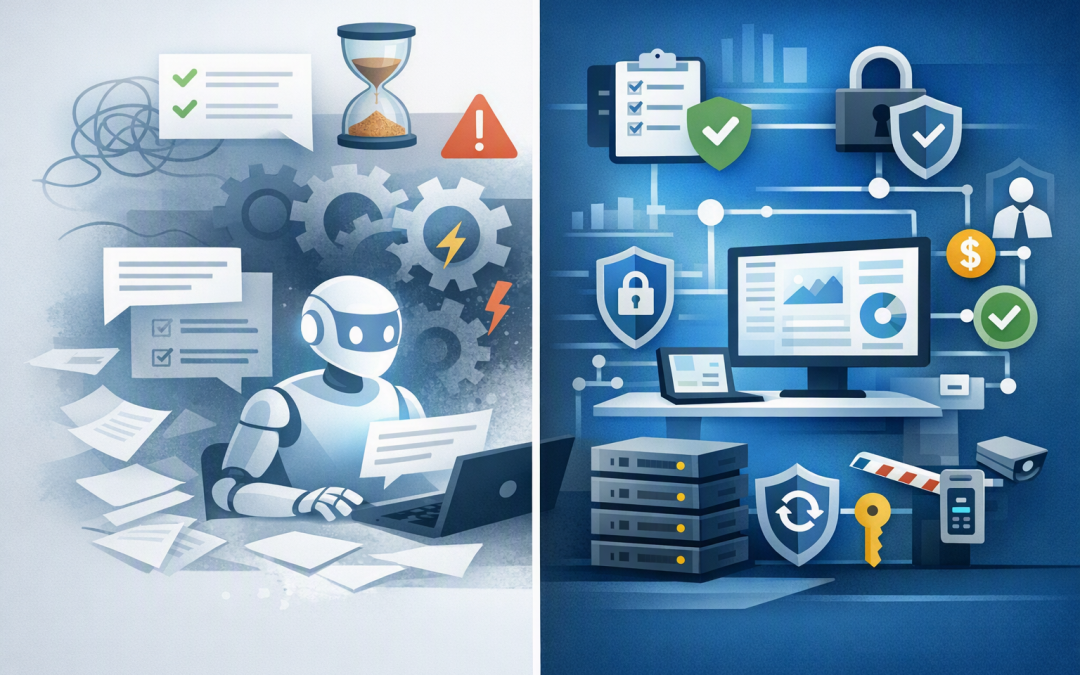
In this blog post Why Prompt-Only AI Agents Break Down in Complex Business Work, we will explain why an AI agent that performs brilliantly in a demonstration can become unreliable when placed inside a real business process.
The problem is rarely that the prompt is badly written. Complex work involves exceptions, approvals, security rules, system failures and decisions that may take hours or days. A prompt alone cannot provide all the controls needed to manage those moving parts safely.
What is a prompt-only AI agent?
A prompt-only agent is mainly controlled through written instructions given to a large language model such as OpenAI or Anthropic Claude. The prompt describes the agent’s role, the task it should complete, the rules it should follow and the tools it can use.
Those tools might allow the agent to search company documents, read a customer record, create a service ticket or draft an email. The language model reviews the available information and decides what to do next.
This approach is quick to build and useful for simple, low-risk tasks. Our guide to Azure Foundry prompt agents and hosted agents explains where this simpler model fits and when custom application logic becomes necessary.
Why impressive demonstrations can be misleading
A demonstration normally uses clean data, predictable questions and a cooperative user. The agent completes one task from beginning to end, often without interruptions or unusual conditions.
Real business work is messier. Records are incomplete, policies conflict, people change their minds and connected systems become unavailable. A customer may also reply three days later, after the agent’s original session has expired.
A prompt can tell the agent to be careful, but it cannot guarantee that every required step will happen in the right order. It is guidance for the model, not a reliable business process.
Five points where prompt-only agents break down
1. The agent loses track of long-running work
Language models work with a limited amount of active information, commonly called a context window. In plain English, this is the information the model can consider during a particular interaction.
As a process becomes longer, older details may be summarised, removed or overlooked. The agent might forget that finance requested a revised purchase amount or that a manager approved only part of an order.
Business workflows need persistent state, meaning important details are stored outside the conversation and can be restored later. For processes that must survive delays, restarts and system failures, durable AI agents provide a more dependable model.
2. Instructions do not guarantee execution order
You can write, “Check the contract, confirm the budget, obtain approval and then create the order.” The model may usually follow that sequence, but usually is not good enough when money, customer data or legal commitments are involved.
A controlled workflow defines the sequence in software. The AI can still interpret documents and prepare recommendations, but it cannot skip mandatory checks simply because it believes it already has enough information.
A plain-English version might look like this:
Receive request
Validate required information
Check policy and budget
Ask the AI to prepare a recommendation
Pause for human approval if risk is high
Complete the approved action
Record the result and notify the requester
This structure separates judgement from control. The AI handles work that benefits from language and reasoning, while fixed rules protect the steps the business cannot afford to miss.
3. Exceptions turn into expensive manual clean-up
What happens if the finance system is unavailable after the agent has already emailed the customer? What if one document succeeds but the next action fails? Telling the agent to “try again” can create duplicate records or repeated charges.
Reliable agents need checkpoints, which are saved recovery points, as well as clear retry and escalation rules. They should know which steps have completed, which can safely be repeated and when a person must take over.
Without this structure, employees spend time investigating half-finished work. Any productivity gain from AI can quickly disappear into support tickets, data correction and customer follow-up.
4. Human approval becomes optional in practice
Many organisations add a sentence such as “ask for approval before taking important actions” to the prompt. The difficulty is that the model must decide what counts as important.
Approval requirements should instead be enforced outside the prompt. For example, an agent might draft a supplier payment, but the payment tool should remain unavailable until an authorised person approves the amount.
This matters for Australian organisations managing privacy obligations and Essential Eight expectations. Essential Eight is the Australian Signals Directorate’s baseline set of cyber security controls. An AI project should not weaken existing controls around identity, administrator access and audit records.
5. It becomes difficult to explain cost and performance
Prompt-only agents can repeatedly reread long instructions and large document sets. They may also call unnecessary tools or spend several steps trying to correct an earlier mistake.
Good prompt design still matters, and our article on reducing AI costs through better prompts covers practical improvements. However, prompt optimisation cannot fix a process that has no limits, measurements or defined route.
A production agent should record how long tasks take, where failures happen, which tools are used and when people intervene. This information lets leaders compare the cost of the agent with the cost and quality of the process it replaced.
A realistic business scenario
Imagine a 200-person professional services company building an agent to onboard new employees. The initial demonstration is excellent: the agent reads a form, drafts a welcome email and prepares requests for Microsoft 365 access.
Problems appear when the agent encounters a contractor, a delayed start date or a role requiring access to sensitive client files. It may create accounts too early, request the wrong licence or continue without the appropriate manager’s approval.
A safer design uses the AI to interpret the onboarding request and recommend access. A workflow then validates the start date, checks the worker type, routes sensitive access for approval and uses Microsoft Intune—which manages and secures company devices—to confirm that the employee’s device meets company requirements.
If a system is unavailable, the workflow saves its progress and resumes later. Every decision and approval is recorded, reducing manual follow-up while giving IT and management a clear audit trail.
When is a prompt-only agent still the right choice?
Prompt-only agents are useful when the task is short, reversible and low risk. Examples include summarising internal documents, drafting meeting notes, answering common policy questions or helping an employee find information.
They become a poor fit when the task moves money, changes access, updates important records or makes commitments to customers. The more systems, approvals and exceptions involved, the stronger the case for a controlled workflow or hosted agent.
It also helps to decide whether the agent is supporting a conversation or completing a defined task. Our comparison of task-based and conversation-based AI agents provides a practical starting point.
What IT leaders should require before production
- A defined business outcome: Specify the time saved, cost reduced or risk lowered.
- Clear process boundaries: Document what the agent may do and what it must never do.
- External state storage: Keep important progress and decisions outside the conversation.
- Enforced approvals: Use system controls rather than relying on polite instructions in a prompt.
- Failure recovery: Design for unavailable systems, incomplete data and interrupted sessions.
- Identity and access controls: Give the agent only the permissions required for its job.
- Monitoring and cost limits: Track actions, model usage, errors and unexpected behaviour.
- A shutdown process: Plan how to stop access and preserve evidence using an emergency off switch for AI agents.
Build the process, not just the prompt
The key lesson is not that prompt agents are bad. They are fast, affordable and valuable when the job is appropriately limited.
The mistake is expecting a prompt to replace workflow design, security controls, recovery planning and operational ownership. Complex business work needs AI reasoning inside a controlled system, not AI reasoning instead of one.
CloudPro Inc combines more than 20 years of enterprise IT experience with hands-on expertise across Microsoft Azure, Microsoft 365, Microsoft Intune, OpenAI, Claude, Microsoft Defender and Wiz. As a Melbourne-based Microsoft Partner and Wiz Security Integrator, we help organisations design agents that are useful in production, not only impressive in demonstrations.
If you are unsure whether your planned agent needs a better prompt or a more dependable architecture, we are happy to review the use case and explain the practical options—no strings attached.
Discover more from CPI Consulting
Subscribe to get the latest posts sent to your email.