
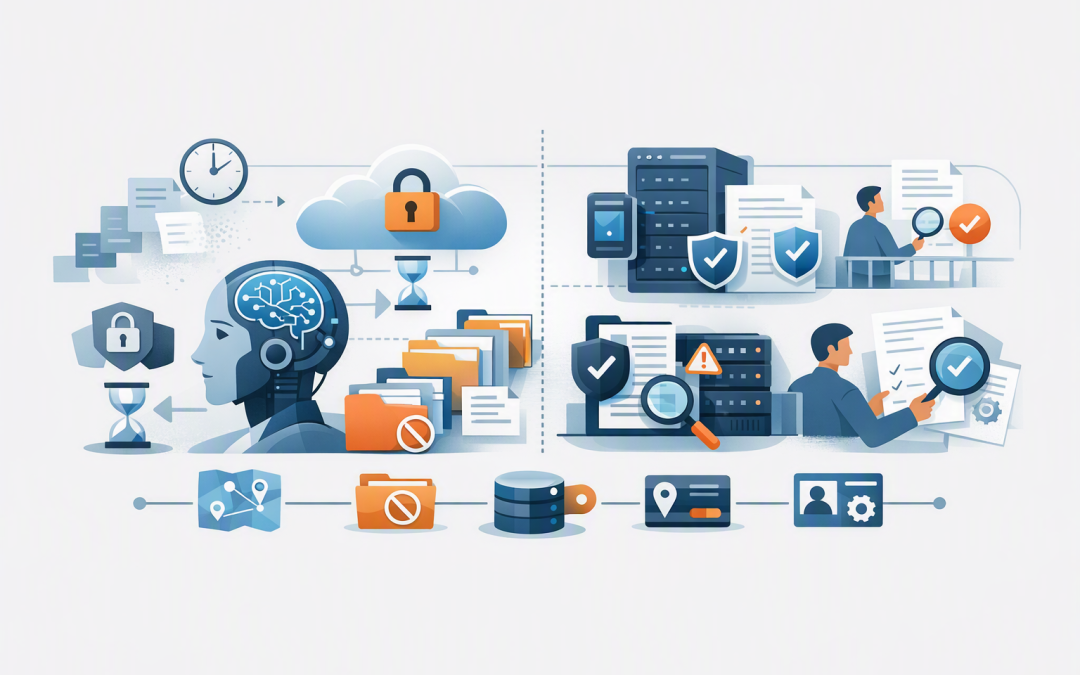
In this blog post How CPI Helps Businesses Choose a Safe AI State Strategy That Works we will explain how to give business AI enough memory to be useful without creating an uncontrolled store of sensitive information.
Many organisations discover the problem after an AI pilot begins to grow. The assistant forgets important context, repeats completed work or produces inconsistent answers. The quick fix is often to retain every conversation, document and action indefinitely.
That may improve continuity, but it can also create privacy exposure, higher storage costs and a large pool of business information that attackers would value. Safe AI state management is about finding the right balance between useful memory and responsible control.
What AI state management actually means
AI state is the information an AI system uses to understand what has already happened. It might include previous messages, a user’s preferences, the current stage of a workflow, documents the AI has reviewed or an approval that is still outstanding.
The AI model itself does not automatically remember everything forever. Your application must decide what information to provide, what to store, where to store it and when to delete it. Those decisions form your state management strategy.
In practice, business AI usually works with four different types of state:
- Conversation state keeps track of the current discussion so users do not need to repeat themselves.
- Workflow state records where a task is up to, such as whether an invoice has been checked or a manager has approved a request.
- Long-term memory retains selected facts across sessions, such as a customer preference or an agreed business rule.
- Retrieved knowledge brings in approved information from Microsoft 365, databases or business systems when needed, rather than permanently adding it to the AI’s memory.
These categories should not be treated the same. A temporary chat about a meeting may only need to exist for a few hours. A financial approval record could require a longer retention period, strict access controls and a complete audit trail.
Why storing everything is usually the wrong answer
Keeping all AI interactions can feel safer because nothing gets lost. In reality, it often creates a new information repository that nobody fully understands or manages.
Staff may enter customer details, employment matters, commercial agreements or internal security information into an AI tool. If that information becomes long-term state, the business needs to know who can access it, whether it leaves Australia, how it is protected and how it can be deleted.
This matters under the Australian Privacy Act and the Australian Privacy Principles when personal information is involved. The Essential Eight, the Australian Government’s cybersecurity framework that many organisations use as a security baseline, also supports the surrounding controls needed to protect identities, devices, applications and backups.
The safest strategy is therefore not “remember everything” or “remember nothing”. It is to retain the minimum useful state for a defined business purpose.
How CPI designs the right state strategy
1. Start with the business process rather than the AI model
CPI begins by mapping what the AI is expected to achieve. Is it answering staff questions, preparing customer responses, processing documents or taking actions across several systems?
We identify where memory creates measurable value and where it simply creates risk. A customer service assistant may need the current case history, for example, but it probably does not need permanent access to every conversation the customer has ever had.
This work often builds on an AI audit before scaling. The audit identifies the data, systems, costs and risks that must be understood before selecting a storage design.
2. Classify what the AI is allowed to remember
Not all state has the same business impact. CPI separates information into practical categories such as public, internal, confidential and highly restricted.
We then establish simple rules. An AI assistant might retain a preferred report format but be prohibited from storing passwords, payment details, health information or sensitive employee records in long-term memory.
This reduces the consequences of a breach and helps the business meet privacy obligations. It also lowers storage and processing costs because the AI is not repeatedly loading unnecessary conversation history.
3. Choose where the state will live
State can be held temporarily within the application, managed by an AI platform or stored in customer-controlled Azure services. Each option has different implications for cost, data residency, recovery and administration.
For lower-risk use cases, platform-managed conversation state may be appropriate. For sensitive workflows, CPI may recommend customer-controlled storage in the organisation’s Azure environment, with access limited through Microsoft Entra ID, which manages staff identities and permissions.
Our experience across Microsoft Azure, OpenAI and Anthropic Claude helps us avoid designing around one vendor’s features. The state layer can be kept separate from the model where appropriate, making it easier to change models without losing business records or rebuilding the entire application.
4. Separate memory from authority
An AI remembering that a supplier usually receives a particular discount does not mean it should be allowed to apply that discount automatically. Memory provides context; authority determines what the AI can actually do.
High-impact actions should have additional controls, such as checking current business data, confirming the user’s permissions and requesting human approval. This is particularly important for payments, customer record changes, legal communications and employee decisions.
Our guide to Azure AI agent architecture explains how secure work areas, controlled system access and approval gates keep decision-makers in control.
5. Set retention, deletion and recovery rules
Every type of state should have an owner and a retention period. Temporary conversation context might disappear when a task ends, while an approval record may need to be retained under the organisation’s existing records policy.
CPI also plans for correction and recovery. If the AI saves an incorrect preference or workflow status, authorised staff need a straightforward way to update it. If state becomes corrupted, the business should be able to restore a known good version without rebuilding the process manually.
A simplified policy record might look like this:
{
 "state_type": "workflow",
 "data_classification": "internal",
 "storage": "customer_controlled_azure",
 "retention_days": 30,
 "human_approval_required": true,
 "audit_logging": true
}
This is not production code. It demonstrates the decisions that should be made explicitly instead of being left to an application’s default settings.
A practical business scenario
Consider a 200-person professional services firm introducing an AI assistant to prepare project updates. The original design stored complete conversations, source documents and draft responses for every employee.
A review found that most of this information was unnecessary after the update was approved. It also included customer names, financial figures and comments copied from private Teams discussions.
A safer design kept temporary conversation context during drafting, stored the final approved update in the existing document management system and retained only a reference number in the AI workflow. Sensitive source content was retrieved when authorised rather than duplicated into permanent memory.
The result was a smaller security exposure, clearer privacy handling and lower ongoing AI processing costs. Employees still received useful continuity, but the business did not create a second uncontrolled archive.
State becomes more important when multiple agents work together
When several AI agents share work, state determines which agent knows what, which actions have already occurred and who is responsible for the next step. Poorly managed shared state can cause duplicated actions or expose information to an agent that does not need it.
CPI defines clear boundaries between agents and uses controlled interfaces for exchanging only the required information. Our article on using A2A and MCP together explores how agents and business tools can communicate without granting broad, uncontrolled access.
Turn the strategy into a working system
A good diagram is not enough. The controls must work with real users, real data and the exceptions that occur in everyday business.
Through forward deployed engineering, CPI works alongside internal teams to build and test the state design. We validate permissions, retention, approvals, monitoring and recovery before the system expands across the organisation.
As a Microsoft Partner and Wiz Security Integrator, CPI can also connect AI state controls with Microsoft Defender and Wiz, which identify security weaknesses and suspicious activity across cloud environments. This provides technology leaders with visibility rather than asking them to trust a black box.
Useful AI should remember selectively
The goal of AI state management is not perfect memory. It is reliable business continuity without unnecessary data, cost or risk.
With more than 20 years of enterprise IT experience, CloudPro Inc helps organisations choose what their AI should remember, where that information should live and which controls should surround it. Our Melbourne-based team supports businesses across Australia and internationally with practical, hands-on guidance rather than a one-size-fits-all platform.
If you are unsure what your AI tools are currently storing, or whether your proposed agent has too much memory and authority, we are happy to review the design with you — no strings attached.
Discover more from CPI Consulting
Subscribe to get the latest posts sent to your email.