
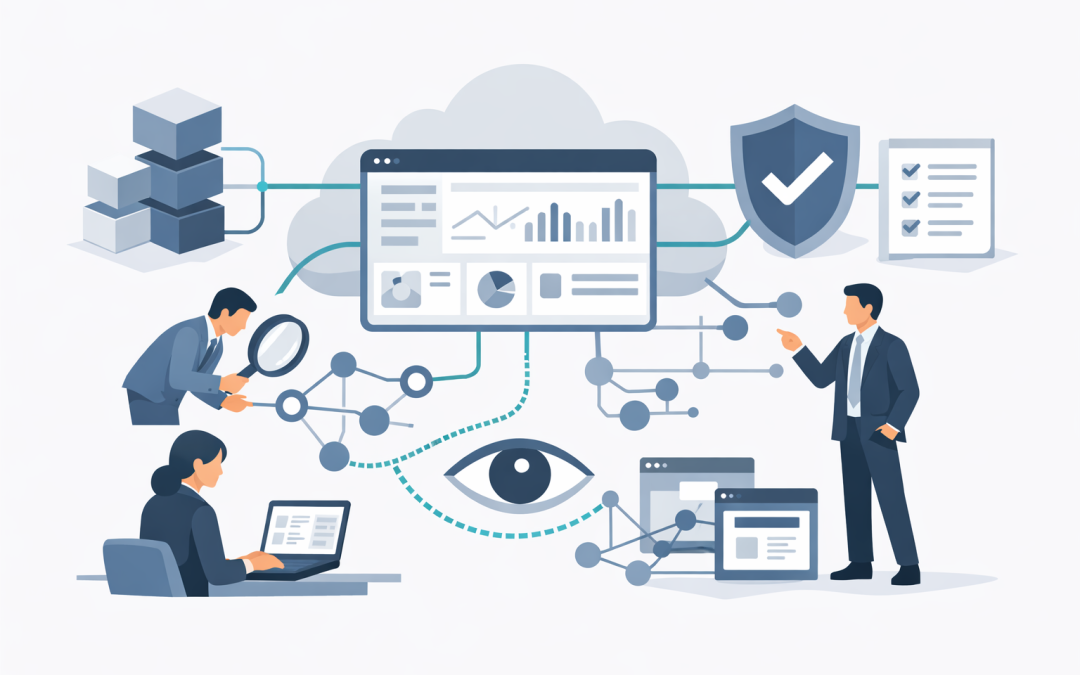
Most mid-market Australian organisations are past the AI proof-of-concept stage. The models work. The board is asking for the next phase. And suddenly the questions nobody planned for are piling up.
Where do the models run? Who approves new deployments? How does the organisation trace what an agent did when it produced an incorrect answer for a customer? What happens when the team that built the prototype moves on?
These aren’t hypotheticals. They are the default reality for organisations between 50 and 500 employees entering 2026 without a coherent AI platform strategy.
Microsoft AI Foundry — now officially called Microsoft Foundry — directly addresses this gap. For CIOs building their 2026 vendor evaluation shortlist, it deserves serious consideration. Here is why.
The Real Evaluation Criteria Have Changed
Two years ago, the vendor evaluation question was simple: which platform gives access to the best models? That question is now irrelevant. Every major cloud provider offers access to GPT-4o, Claude, Llama, and dozens of other foundation models.
The questions that matter in 2026 are different. Can the platform govern AI assets across the entire organisation? Does it provide trace-level visibility when an agent chains multiple tools and models? Can the compliance team audit what happened without calling the engineering team?
CIOs who are still evaluating AI platforms based on model access alone are evaluating the wrong criteria.
A Single Control Plane for Everything AI
Microsoft Foundry consolidates agents, models, and tools under one Azure resource with unified role-based access control, networking, and policies. This is not a marketing repackaging exercise — it represents a genuine architectural consolidation.
The previous approach required managing separate Azure OpenAI, Azure AI Services, and Azure Machine Learning resources across different portals with different RBAC models. Foundry collapses this into a single resource provider namespace. One control plane. One set of policies. One audit surface.
For CIOs reporting to boards on AI governance, this consolidation changes the conversation from “we manage AI across fifteen services” to “here is our AI governance dashboard.”
Model Flexibility That Absorbs Market Churn
Foundry Models provides access to over 11,000 models — including GPT-4o, Claude Opus, DeepSeek-R1, Phi, Llama, and Mistral — through a single catalogue. The built-in model router automatically directs requests to the most suitable model based on quality and cost thresholds defined by the organisation.
This matters because the model landscape shifts every quarter. The model an organisation selects today will not be the best option in six months. A platform that absorbs this churn without forcing architecture changes or expensive replatforming exercises has tangible commercial value.
Organisations can benchmark and compare models side by side before committing to a deployment. When a better model arrives next quarter, switching happens at the configuration level rather than requiring engineering rework.
Enterprise Governance That Speaks to Boards and Regulators
The Foundry Control Plane is where the platform becomes particularly compelling for Australian enterprises. It provides centralised management of all agents, models, and tools across the organisation.
Key governance capabilities include:
- Unified RBAC — A single access control model across every AI asset
- Azure Policy integration — Guardrail policies defined once, enforced fleet-wide
- Full audit trails — Versioned policies with complete auditability
- Compliance monitoring — Real-time dashboards with bulk remediation for noncompliant configurations
- Authentication controls — Full support for both MCP and A2A protocols
For Australian organisations working toward Essential 8 maturity levels or aligning with ACSC guidelines, having a single governance surface for AI assets simplifies compliance from a multi-week discovery exercise to a structured dashboard review.
The integration with Microsoft Defender and Microsoft Purview means AI governance slots into existing security and compliance tooling rather than requiring a parallel stack.
Agent Orchestration Built for Production
Many organisations have built impressive AI demos. Far fewer have deployed agents into production with proper observability, memory management, and multi-step workflow orchestration.
Foundry’s Agent Service provides production-grade capabilities that mid-market organisations would otherwise need to build from scratch:
- Multi-agent orchestration with defined workflows in Python and C#
- A tool catalogue with over 1,400 connectors
- Conversation memory that persists context across interactions
- Direct publishing to Microsoft Teams or Microsoft 365 Copilot
For organisations already invested in the Microsoft ecosystem — which describes the vast majority of Australian mid-market businesses — deploying agents directly into Teams and M365 Copilot eliminates an entire custom integration layer.
Observability Across the Full Agent Chain
Most AI monitoring focuses on individual model calls. When an agent chains three tools, two model calls, and a knowledge lookup, organisations need trace-level visibility across the entire sequence.
Foundry delivers built-in tracing for agent workflows, continuous evaluation dashboards, and model performance monitoring — accessible from the portal without bolting on additional monitoring infrastructure.
The integrated AI Red Teaming Agent deserves particular attention. Automated vulnerability probing and regression testing, built directly into the management plane. Microsoft is shipping offensive security testing for AI as a platform feature. Most Australian organisations have not yet considered this a requirement, but it significantly raises the security baseline for any AI deployment.
Why This Matters for Mid-Market Australia
Large enterprises with dedicated AI platform teams can afford to build custom orchestration layers, write bespoke governance tooling, and hire specialists for every component. Mid-market organisations with 50 to 500 employees cannot.
The AI platform decision in 2026 is fundamentally a build-versus-buy decision. Build a custom stack from open-source components and hope it stays maintainable? Or adopt a managed platform that handles the undifferentiated heavy lifting?
Microsoft Foundry tilts this equation decisively toward the managed platform. The unified SDK (azure-ai-projects 2.x) replaces what used to be five separate packages with one project client against one endpoint. The single resource model eliminates the infrastructure complexity of managing multiple Azure resources.
For organisations already running Microsoft 365 and Azure, the adoption path is straightforward. Foundry works within existing Azure subscriptions, leverages existing Entra ID configurations, and respects existing network architectures, RBAC models, and compliance policies.
The Evaluation Framework CIOs Should Use
When assessing Microsoft Foundry against alternatives, the evaluation should focus on five areas:
- Governance consolidation — Does the platform provide a single control plane for all AI assets with unified policy enforcement?
- Model portability — Can the organisation switch models without re-engineering the application layer?
- Production readiness — Does the platform provide agent orchestration, memory, and observability out of the box?
- Ecosystem fit — Does the platform integrate natively with existing identity, security, and productivity tools?
- Compliance alignment — Can the organisation demonstrate AI governance to auditors and regulators from a single surface?
Microsoft Foundry scores strongly across all five. That does not mean it is the right choice for every organisation — but it does mean it belongs on the shortlist.
The Bottom Line
AI platform decisions made in 2026 will shape how organisations operate for the next three to five years. Choosing incorrectly means either expensive replatforming or growing technical debt that compounds with every new agent deployed.
Microsoft Foundry offers a genuinely integrated approach to enterprise AI — one that covers models, agents, governance, and observability under a single management surface. For Australian mid-market organisations already in the Microsoft ecosystem, the integration advantages are substantial.
Organisations building their 2026 AI vendor evaluation list should include Microsoft Foundry as a serious contender. The platform has matured past the preview stage into a production-grade offering that addresses the governance and operational questions boards are now asking.
CloudProInc works with Australian organisations to evaluate, design, and implement enterprise AI platforms. For a confidential discussion about how Microsoft Foundry fits within an existing technology strategy, reach out to our team.