
Most organisations are still treating AI coding as a premium activity.
The strongest model gets used for everything. Simple refactors, codebase search, documentation cleanup, test fixes, and multi-step agent workflows all get pushed through the same expensive reasoning layer. That made sense when smaller models were visibly weaker. It makes less sense now.
OpenAI’s March 17 release of GPT-5.4 mini and nano changes that equation. For technical leaders building internal developer platforms, coding copilots, and agent-based engineering workflows, the real story is not just better model performance. It is a new cost and architecture model for how enterprise software teams should split work across AI systems.
The Problem Most Teams Created for Themselves
Many AI coding rollouts started with a sensible assumption: use the best available model to maximise quality, then optimise later.
The issue is that “later” rarely comes. Engineering teams end up with one expensive default model handling everything from targeted edits to large-scale planning. Once adoption grows, cost surprises follow. Latency becomes another problem. Developers stop trusting the tool when small tasks take too long or usage caps appear too early.
That problem gets worse in agentic workflows. Once teams start chaining search, file reading, review, test execution, and documentation tasks together, they are no longer paying for one answer. They are paying for orchestration across many steps.
This is exactly where smaller, faster models become strategically important.
What OpenAI Actually Announced
OpenAI says GPT-5.4 mini is more than 2x faster than GPT-5 mini while improving across coding, tool use, reasoning, and multimodal tasks. In the API, it supports text and image inputs, tool use, function calling, web search, file search, computer use, and skills. It also has a 400k context window.
The pricing is what should make enterprise buyers stop and recalculate. GPT-5.4 mini is priced at $0.75 per 1 million input tokens and $4.50 per 1 million output tokens. GPT-5.4 nano is even cheaper at $0.20 per 1 million input tokens and $1.25 per 1 million output tokens.
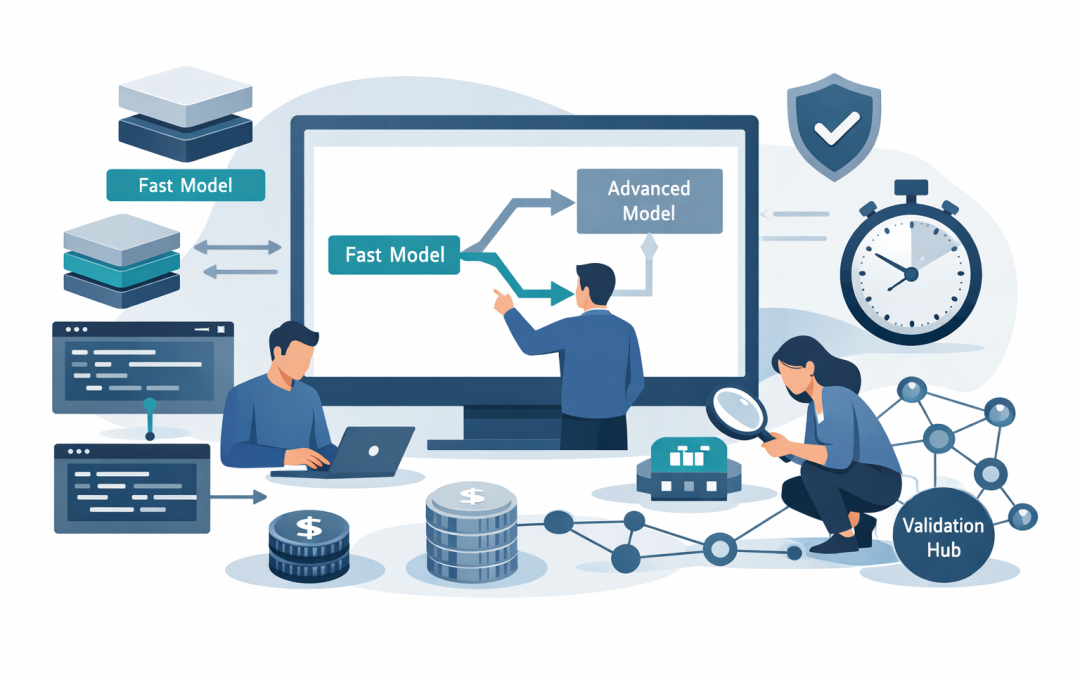
OpenAI is also being unusually explicit about the intended architecture. GPT-5.4 mini is positioned as a strong subagent model. In Codex, a larger model can handle planning and final judgment while delegating narrower tasks such as codebase search, large-file review, or supporting document processing to GPT-5.4 mini in parallel.
That design pattern matters far beyond OpenAI’s own products.
This Is Not Just a Better Mini Model
On paper, benchmark gains are notable. OpenAI reports GPT-5.4 mini at 54.4% on SWE-Bench Pro and 60.0% on Terminal-Bench 2.0, approaching the larger GPT-5.4 model while running much faster. On OSWorld-Verified, it reaches 72.1%, materially ahead of GPT-5 mini.
But the bigger issue for enterprise teams is workload separation.
For the last year, a lot of AI coding products were built around a hidden assumption: smaller models were for low-value tasks, and serious engineering still needed the flagship model. GPT-5.4 mini weakens that assumption. It is now strong enough to take on a large share of production engineering work that does not require maximum-depth reasoning.
That changes both pricing strategy and platform design.
GitHub Copilot Confirms the Direction
GitHub moved quickly. On March 17, GitHub announced that GPT-5.4 mini is now generally available for GitHub Copilot across Pro, Pro+, Business, and Enterprise plans. It is available across Visual Studio Code, JetBrains, Visual Studio, GitHub CLI, GitHub Mobile, and github.com, with organisation admins able to enable it through Copilot policies.
GitHub’s own description is revealing. It calls GPT-5.4 mini OpenAI’s latest fast version of its agentic coding model and says early tests show strong performance in codebase exploration and grep-style workflows. That is exactly the kind of work that appears constantly in real engineering environments but does not always justify a flagship-model bill.
For enterprise teams, this means the cost model is no longer theoretical. It is already being operationalised inside one of the most widely deployed developer AI platforms.
What This Means for Enterprise Architecture
There are three practical implications.
First, coding AI should be tiered by task, not standardised on one model. High-cost reasoning should be reserved for planning, architecture-level changes, and final validation. Lower-cost models should absorb code search, repetitive edits, test repair, documentation generation, and other bounded subtasks.
Second, AI coding platforms should be measured on blended economics, not just model quality. If a workflow completes in half the time at a materially lower cost, that matters more than using the most prestigious model name. CIOs and engineering leaders should ask vendors how they split workloads across models and what controls exist for policy-driven routing.
Third, agent design matters more than prompt design. The winning pattern is increasingly a supervisor model plus supporting subagents, each tuned to a specific class of work. That means enterprises need better observability, cost tracking, and approval rules across multi-step AI workflows.
Why Mid-Market Organisations Should Care
For organisations between 50 and 500 employees, this matters even more than it does for large enterprises.
Large firms can absorb inefficient AI spend for longer. Mid-market organisations cannot. If every coding or automation workflow depends on the highest-priced model, AI adoption will eventually hit a budget ceiling. That is often the point where pilots stall and leadership confidence drops.
GPT-5.4 mini creates a more workable path. Teams can design internal copilots and engineering agents that are fast enough to be used every day and cheap enough to scale across more developers, analysts, and IT staff.
It also aligns with how Australian organisations increasingly evaluate technology investments. The question is no longer whether the demo works. The question is whether the operating cost remains sensible once usage becomes normal.
A Better Decision Framework for CIOs and CTOs
When reviewing AI coding platforms in 2026, leaders should ask five blunt questions:
- Which tasks actually require premium reasoning, and which do not?
- Can the platform route work across multiple models by policy?
- How is usage monitored at the team and organisational level?
- What controls exist for agent-driven actions such as file changes, test runs, or CLI execution?
- What does the blended cost per completed workflow look like at scale?
These are stronger evaluation questions than “Which model scores highest on a benchmark?” They are also the questions that determine whether AI coding becomes an operational advantage or just another costly experiment.
The Bottom Line
GPT-5.4 mini does not replace flagship models.
What it does is make one-model AI architecture harder to defend. Enterprise coding and agent workflows now have a credible smaller-model option that is faster, cheaper, and good enough for a much larger share of production work than many teams assumed.
The organisations that benefit most will be the ones that redesign their AI workflows around that reality early. They will treat premium models as scarce judgment layers, not as the default engine for every step.
CPI helps Australian organisations design practical AI operating models across coding, cloud, and cybersecurity. If your team is reviewing how to scale AI-assisted development without blowing out cost or governance risk, our team can help map the right architecture.