
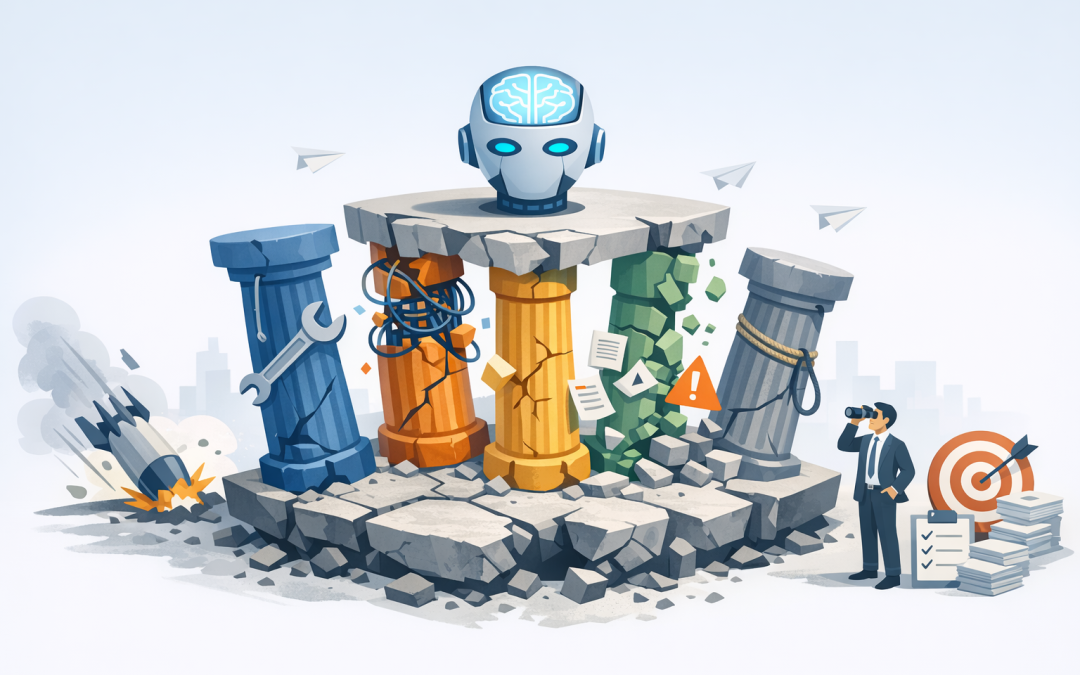
In this blog post Why Most AI Agent Projects Fail and How to Avoid Costly Mistakes we will explain what AI agents actually are, why so many projects disappoint, and how to build something useful, secure, and worth the investment.


A lot of business leaders are feeling the same pressure right now. The board is asking about AI. Competitors are talking about automation. Staff are already using tools like ChatGPT or Copilot in pockets of the business. So the natural next question is, should we build an AI agent?
At a high level, an AI agent is software that can do more than just answer a question. It uses a large language model such as OpenAI or Anthropic Claude as the brain, then connects that brain to tools, data, and business rules so it can complete multi-step work. For example, instead of just writing an email, an agent might read a support request, check a knowledge base, draft a reply, update a ticket, and ask a manager for approval.
That sounds powerful, and it is. But it also explains why AI agent projects fail. The moment an agent can take action inside your business, you are no longer dealing with a simple chatbot. You are dealing with process design, access to company systems, privacy, cybersecurity, and accountability.
What most companies get wrong from day one
They start with the technology, not the problem
The first mistake is surprisingly common. A leadership team decides they want an AI agent because everyone else seems to be building one, but nobody has clearly defined what business problem it should solve.
That usually leads to vague goals like “improve productivity” or “automate operations.” They sound sensible, but they are too broad to build around. A better starting point is specific and commercial: reduce time spent triaging service desk tickets by 40%, cut proposal preparation from six hours to three, or reduce overdue invoice follow-up by one day.
If the business outcome is unclear, the project becomes a demo instead of a solution. You may end up with something impressive in a workshop that never becomes part of day-to-day operations.
They aim for full autonomy too early
Many teams jump straight to the most ambitious version of the idea. They want an agent that can make decisions, trigger workflows, talk to multiple systems, and run without much human input.
In practice, that is usually the wrong place to start. The most successful projects are often much simpler. They begin with a tightly defined workflow where the AI handles the repetitive first draft or first pass, and a person remains in control of the final decision.
Think of it this way. An AI agent should earn trust in stages. First it assists. Then it recommends. Only later, if the process is stable and the risks are low, should it act more independently.
This matters because every extra layer of autonomy adds cost, complexity, and risk. It also makes the project harder to test, explain, and govern.
The technology behind AI agents in plain English
Business leaders do not need to understand code to make good decisions about AI, but it helps to understand the moving parts.
Most AI agents are made up of four simple pieces. First, there is the model, which is the language engine that reads instructions, reasons through tasks, and writes responses. Second, there are tools, which let the agent do things like search documents, read emails, update a CRM, or raise a ticket. Third, there is memory or state, which helps the agent keep track of the task it is working on. Fourth, there are rules and guardrails, which define what the agent is allowed to access, what it must never do, and when a human needs to step in.
When one of those pieces is weak, the whole project struggles. A smart model with poor data will still make poor decisions. A useful tool with no security controls becomes a risk. An agent with no handoff process creates rework instead of saving time.
Why good ideas break in the real world
The data is messy or the system access is too broad
An AI agent is only as useful as the information it can rely on. If your policies are out of date, files are spread across shared drives, naming is inconsistent, and nobody agrees on the latest version of a document, the agent will not magically fix that. It will simply surface the mess faster.
There is a second problem here as well. To be helpful, agents often need access to email, SharePoint, Teams, finance systems, customer data, or internal knowledge bases. If that access is granted too broadly, you create a security and privacy problem. If access is too limited, the agent cannot do its job.
This is where many businesses get caught. They treat the AI agent like a clever add-on, when in reality it behaves more like a new digital worker. It needs the right identity, the right permissions, and close supervision.
Governance is treated as an afterthought
For Australian businesses, this matters more than many realise. If an AI agent handles personal information, customer records, staff details, or commercially sensitive documents, privacy and compliance obligations do not disappear because the tool feels new.
That is why AI should sit inside the same governance conversation as cybersecurity and risk. The Australian government’s Essential 8, which is the cybersecurity framework many organisations now use to reduce common threats, is still highly relevant here. So are the privacy expectations around how personal information is collected, used, stored, and disclosed.
In plain English, that means asking practical questions before rollout. What data can the agent see? Where is that data stored? Who approved the use case? Are actions logged? Can a person override the decision? If the agent produces something wrong, who catches it before damage is done?
For businesses already invested in Microsoft 365 and Azure, this is one reason it often makes sense to build inside a platform that already supports identity controls, security monitoring, device management, compliance features, and audit trails, rather than allowing staff to experiment with a collection of disconnected tools.
No one owns success after launch
Another reason projects fail is simple. After the pilot, nobody owns the outcome.
The IT team may own the technical setup. Operations may own the process. Department heads may want the productivity gain. But if there is no single accountable owner for business results, the project drifts. Usage drops, edge cases pile up, and confidence disappears.
Every AI agent project needs a named business owner, a named technical owner, and a short list of success measures. That could be time saved, fewer manual touches, faster customer response, fewer errors, or reduced outsourcing cost. If you cannot measure the before and after, you cannot prove value.
A better way to approach AI agents
The businesses getting real returns from AI agents tend to follow a much more disciplined path.
Pick one process that is repetitive, time-consuming, and rule-based.
Map the current process before you automate it. If the process is broken, the agent will automate the confusion.
Start with assistance, not full autonomy. Let the agent draft, summarise, classify, or recommend first.
Limit system access to the minimum required. Think least privilege, not open slather.
Keep a human approval step for anything customer-facing, financial, legal, or sensitive.
Measure outcomes from day one and review them every few weeks.
This approach feels less exciting than the “fully autonomous AI workforce” pitch. It is also much more likely to deliver a return.
A real-world scenario
A mid-sized professional services business came to us wanting an AI agent to “run back-office admin.” That was the brief. On paper it sounded ambitious. In reality, it was too broad to succeed.
Once we broke the problem down, two opportunities stood out. The first was proposal preparation, where staff were spending hours pulling information from previous documents, pricing notes, and service descriptions. The second was shared inbox triage, where routine requests were waiting too long for the right team member.
Instead of building one big autonomous agent, the business started with two controlled workflows. One helped assemble a first draft of proposals using approved internal content. The other summarised inbound requests, suggested a response, and routed the item to the right queue for review.
Before anything went live, access was tightened, source documents were cleaned up, and approval points were built in. Within weeks, the business was saving meaningful time in both areas. Just as importantly, leaders could see exactly what the agent was doing, where humans remained accountable, and where to improve next.
That is usually what success looks like. Not magic. Not hype. Just a well-chosen process, better handled.
Where CloudPro Inc fits
This is the kind of work where practical experience matters. With more than 20 years in enterprise IT, CloudPro Inc helps organisations cut through the noise and decide where AI will genuinely improve operations, where it will create new risk, and how to build on the Microsoft and security foundations they already have.
Because we work across Azure, Microsoft 365, Intune, which manages and secures company devices, Windows 365, Microsoft Defender, Wiz, OpenAI, and Claude, we can look at the full picture. Not just the model, but the identity controls, device posture, compliance expectations, cloud architecture, and security gaps that determine whether an AI project succeeds in the real world.
As a Melbourne-based Microsoft Partner and Wiz Security Integrator, our focus is practical rollout, not theatre. That matters for businesses that want results without handing the job to a giant faceless provider.
The bottom line
Most AI agent projects fail for ordinary reasons. The problem is poorly defined. The scope is too ambitious. The data is messy. The controls are weak. The business case is never measured.
The good news is that these problems are avoidable. Start with one valuable workflow. Build inside clear security and privacy boundaries. Keep people involved where judgment matters. Prove a business outcome first, then scale.
If you are not sure whether your AI plans are practical, secure, or likely to deliver a return, CloudPro Inc is happy to take a look and give you a straight answer, no strings attached.