
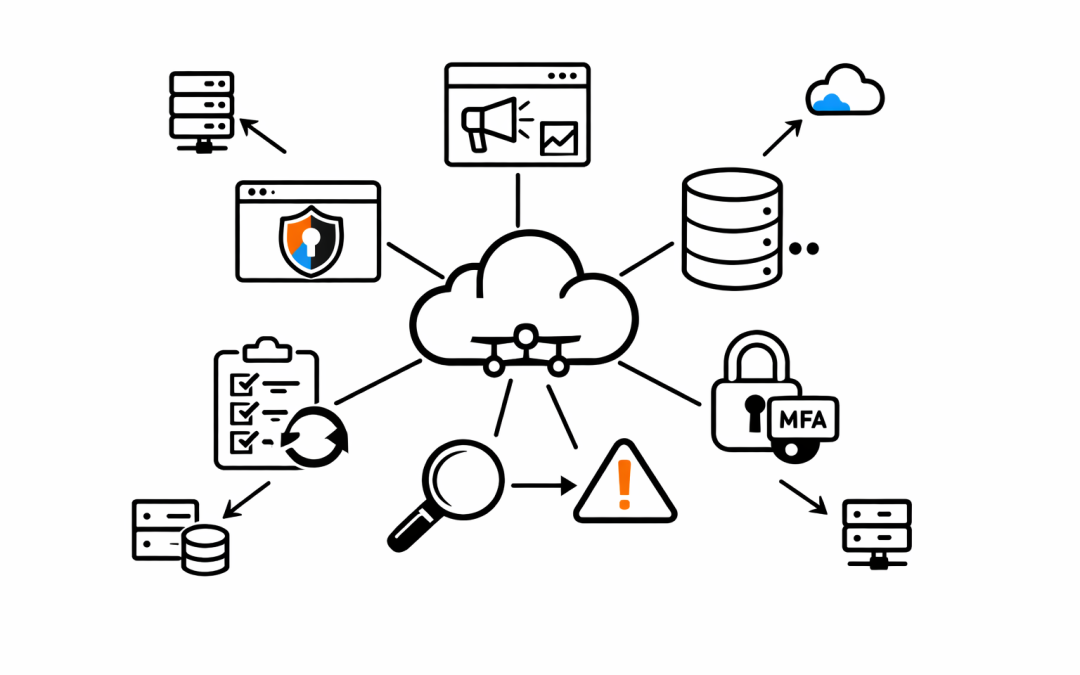
In this blog post, The Vercel Breach Shows Why Third-Party Hosting Belongs in Your Next Azure Well-Architected Review, we look at why platforms like Vercel, Netlify, Cloudflare Pages, and Railway can no longer sit quietly outside the governance perimeter of an Australian mid-market organisation.
Vercel is a hosting platform that runs the front-end of many modern websites and applications. It gives development teams a fast way to publish marketing sites, customer portals, preview environments, and small serverless APIs without setting up their own servers. That speed is exactly why it has quietly crept into the technology estate of many Australian businesses, usually without IT ever signing off on it.
In April 2026, Vercel disclosed a security incident involving abuse of its v0 AI platform and its build and hosting infrastructure, where attackers used the platform to host and distribute malicious content. It sits alongside a broader pattern of attackers abusing trusted Platform-as-a-Service providers in phishing and malware campaigns. That combination turns third-party hosting into a board-level risk topic, not a developer preference.
For CIOs and IT Directors, the lesson is uncomfortable. These platforms sit outside the Azure tenant boundary, but they carry customer data, authentication flows, and brand. They belong inside the next Azure Well-Architected Review.
Why Third-Party Hosting Is Now A Material Risk
Azure remains the core platform for most Australian mid-market organisations. Identity, data, line-of-business applications, and core workloads live inside a well-governed tenant. That part of the estate is usually reviewed, hardened, and monitored.
The problem is what has grown around it. Marketing teams publish campaign sites on Vercel or Netlify. Product teams run Next.js front-ends on Vercel while the APIs run in Azure. Engineering teams spin up preview environments on Cloudflare Pages or Railway for every pull request. Small internal tools end up on a PaaS account tied to a personal email.
Each of these platforms is capable and well engineered. That is not the issue. The issue is that they process customer data, host login flows, handle form submissions, and display the company’s brand, often without the controls that apply everywhere else in the environment.
When a provider like Vercel is abused to distribute malicious content, the risk is not only technical. Customers, partners, and regulators do not draw a clean line between a compromised third-party host and the organisation whose logo appears on the page.
The Governance Gap In Most Well-Architected Reviews
The Azure Well-Architected Review is one of the most useful governance tools available to Australian mid-market organisations. It gives a structured view of Security, Reliability, Cost Optimisation, Operational Excellence, and Performance Efficiency across an Azure environment.
The gap is scope. Most Well-Architected Reviews stop at the edge of the Azure subscription. If a workload lives in Azure App Service, Azure Functions, or Azure Kubernetes Service, it gets reviewed. If the same workload has a front-end on Vercel, an authentication proxy on Cloudflare, and a marketing site on Netlify, those components rarely appear on the diagram.
That leaves a material portion of the customer-facing estate outside the review. It is also where a growing share of incidents now occur, because attackers understand that third-party PaaS platforms are often under-governed, poorly logged, and loosely owned.
A Well-Architected Review that excludes third-party hosting is reviewing half the picture.
What Needs To Change In The Next Review
Third-party hosting should be treated as an extension of the Azure estate for the purposes of the next Well-Architected Review. That means deliberate checks across all five pillars.
Security
- Confirm which third-party PaaS platforms are in use, who owns each account, and which identities have administrative access.
- Require single sign-on through the corporate identity provider and enforce multi-factor authentication on every hosting console.
- Review what data flows through these platforms, including form submissions, analytics, authentication tokens, and cookies.
- Validate that custom domains, DNS records, and TLS certificates are owned and managed by the organisation, not by individual developers.
- Include these platforms in the incident response plan, including who to contact and how logs are retrieved.
Reliability
- Map dependencies end to end, including how an outage at a third-party host affects Azure workloads and customer-facing services.
- Confirm that recovery time and recovery point objectives are documented for content and configuration held on these platforms.
- Test the ability to redeploy a critical front-end to an alternative platform or directly to Azure within an acceptable timeframe.
Cost Optimisation
- Consolidate shadow accounts created on personal emails or corporate cards into a single, governed tenant per platform.
- Review usage tiers and commitments, especially for preview environments and build minutes that accumulate silently.
- Compare the total cost of ownership against Azure Static Web Apps, Azure Front Door, and Azure Container Apps for equivalent workloads.
Operational Excellence
- Treat configuration on third-party platforms as infrastructure as code, versioned in the same repositories as Azure resources.
- Centralise logs from these platforms into the same location used for Azure logs, typically Microsoft Sentinel or Log Analytics.
- Define a change management process for production deployments on third-party hosts that matches the one used for Azure.
- Assign a named owner for each platform, with a clear handover when people leave.
Performance Efficiency
- Validate that front-ends hosted on third-party PaaS meet performance targets for Australian users, including content delivery and regional routing.
- Review whether integration patterns between third-party front-ends and Azure back-ends introduce unnecessary latency or cost.
- Confirm that scaling behaviour under load is understood and tested, not assumed.
The Essential 8 And ACSC Alignment Angle
Australian organisations are increasingly expected to align with the Essential 8, the mitigation strategies defined by the Australian Signals Directorate and promoted by the Australian Cyber Security Centre. Third-party hosting intersects with several of these directly.
Application control becomes meaningful only if the organisation knows what applications and domains represent its brand online. A marketing site on an untracked Vercel account is an application the organisation has implicitly endorsed but not controlled.
Patching applications extends to the frameworks and dependencies deployed on third-party hosts. A forgotten Next.js site on an old runtime is still an exposed asset.
Restricting administrative privileges applies to every hosting console, not only to Azure. Shared logins and personal accounts with production access do not meet this bar.
Multi-factor authentication must be enforced on every platform that can publish content under the organisation’s domain.
Centralised logging is the check that most often fails. If logs from Vercel, Netlify, Cloudflare, or Railway are not flowing into the same place as Azure logs, the organisation cannot detect, investigate, or respond to incidents on those platforms with the same discipline it applies internally.
ACSC’s broader guidance on supply chain risk points in the same direction. Any platform that handles customer data or carries the organisation’s brand is part of the supply chain and should be governed accordingly.
A Practical Next Step
The Vercel incident is a useful prompt, not a reason to panic. Third-party PaaS platforms will remain part of the Australian mid-market technology stack because they genuinely help teams move faster. The goal is not to remove them. It is to bring them inside the same governance that already applies to Azure.
If leadership is not confident that the next Well-Architected Review will cover every platform where customer data lands or the company’s brand appears, that is the gap worth closing first.
CloudProInc runs Azure Well-Architected Reviews that deliberately extend beyond the tenant boundary to include third-party hosting, SaaS, and the integration points in between. If a fresh view across the full estate would be useful before the next board or audit cycle, the team is happy to take a look and share a practical action plan.
Discover more from CPI Consulting
Subscribe to get the latest posts sent to your email.