
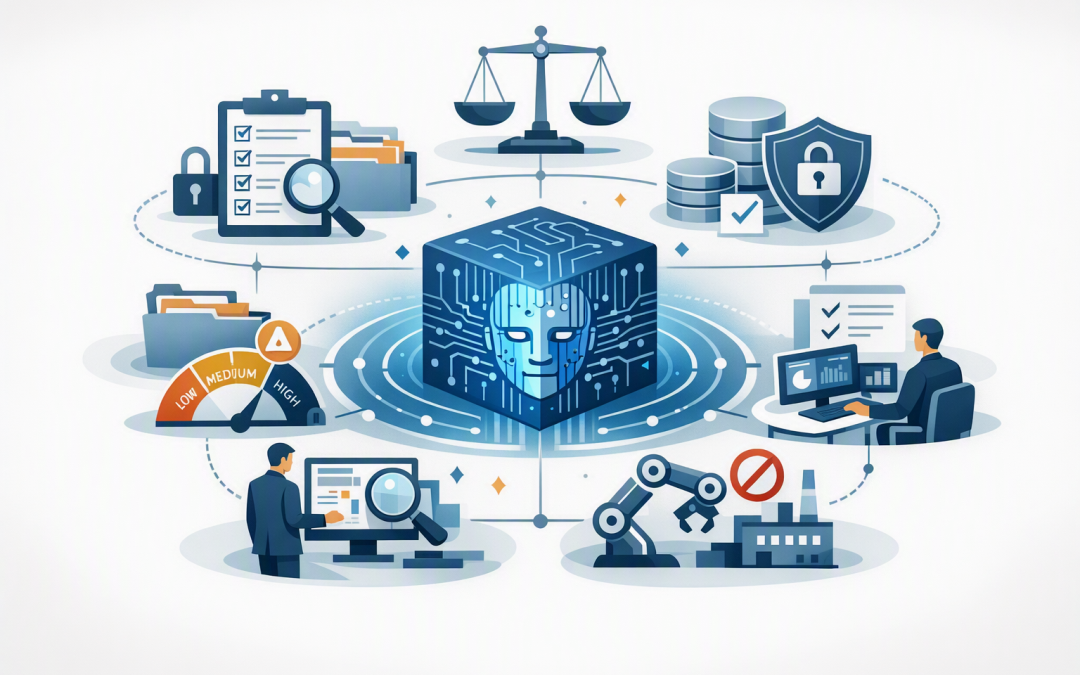
In this blog post The Essential Components of an Enterprise AI Governance Strategy we will explain how to give employees useful access to AI without exposing your business to uncontrolled costs, privacy breaches, unreliable decisions or compliance problems.


Many businesses already have employees using Microsoft Copilot, ChatGPT, Claude and other AI tools. The problem is that senior leaders often cannot say exactly which tools are being used, what information employees are entering, who approved them or what happens when the technology produces a damaging answer.
AI governance is the set of rules, responsibilities and practical controls used to answer those questions. It should help the business adopt AI confidently, rather than becoming a large policy document that prevents anyone from getting useful work done.
Understanding the technology you are governing
Most popular generative AI tools are powered by large language models. In simple terms, these models analyse patterns across enormous amounts of text and predict the most likely response to a request.
They do not understand facts in the same way a person does. A model can produce a confident, professional-sounding answer that is incomplete, biased or simply wrong. This is commonly called a hallucination.
The risk increases when AI is connected to your Microsoft 365 files, customer records, financial systems or internal applications. An AI agent can go further by taking actions, such as updating a record, sending an email or preparing an order, rather than only producing text.
That means governance must cover the entire AI system: the model, the business data it can access, the people using it, the actions it can perform and the external provider supplying it.
1. Clear ownership and decision rights
Every AI system needs a named business owner. This person is accountable for why the system exists, what outcome it should produce and whether its benefits continue to justify its cost and risk.
IT should manage security and technical controls, but it should not decide alone whether AI is appropriate for recruitment, customer service, finance or legal work. Those decisions require input from the relevant business leader, along with privacy, legal, security and risk specialists.
Our guide to AI governance ownership and accountability provides a practical model for dividing these responsibilities without creating unnecessary committees.
2. A complete register of AI systems
You cannot govern tools you do not know exist. Start with an AI register listing approved platforms, experimental tools, AI features built into existing software and systems employees have adopted independently.
The register does not need to be complicated. For each use case, record the following:
AI system or tool:
Business purpose:
Accountable owner:
Employees or customers affected:
Data the system can access:
Actions the system can perform:
Risk rating:
Required human approval:
Vendor and contract owner:
Last review date:
Measured business benefit:
This immediately reveals duplicate subscriptions, unapproved tools and systems with no clear owner. It also gives leadership a reliable view of where AI investment is producing value.
3. Risk assessment based on the use case
Not every use of AI carries the same risk. Using AI to summarise internal meeting notes is very different from using it to reject job applicants, recommend credit decisions or provide health-related advice.
Each use case should be assessed according to the sensitivity of its data, the people affected, the potential impact of an incorrect result and whether the AI can take action without approval.
A simple low, medium and high-risk model is often enough. Low-risk tools may receive quick approval, while high-risk systems require detailed testing, executive sign-off and stronger human oversight.
This keeps governance proportionate. Employees can still use AI for everyday productivity, while the organisation applies greater scrutiny where an error could cause financial loss, unfair treatment or reputational damage.
4. Data privacy and security controls
One of the most common AI risks is an employee entering customer, employee or commercially sensitive information into an unapproved service. Once information leaves the controlled business environment, recovering it may be impossible.
Your strategy should define which information employees may enter into AI tools and which approved platforms can access company data. It should also cover how long information is retained, where it is processed and whether a provider can use it to improve its models.
Security foundations still matter. The Essential 8, the Australian government’s cybersecurity framework that many organisations are expected or required to follow, helps protect the accounts, devices and applications through which employees access AI.
Controls such as multi-factor authentication, timely software updates and restricted administrator access reduce the chance that a compromised account will expose AI-connected business data. Microsoft Defender, which detects threats across devices and cloud services, and Wiz, which identifies cloud security risks, can add visibility across larger environments.
5. Testing and continuous monitoring
An AI system should be tested before launch using realistic examples, including difficult or unusual requests. Testing should examine accuracy, privacy, security, inappropriate responses and whether the system behaves consistently for different groups of people.
Approval is not the end of the process. AI models, connected data and business processes change, so performance must be monitored after deployment.
Useful measures include error rates, staff time saved, customer complaints, security incidents, usage levels and the cost per completed task. If the business cannot measure the outcome, it cannot know whether the AI investment is worthwhile.
6. Meaningful human control
“A human is involved” is not enough if that person automatically approves every AI recommendation. Employees need enough information, authority and time to challenge the system.
High-impact decisions should have clear approval points and an immediate way to stop automated actions. People affected by an AI-supported decision should also have a practical method for requesting a review or correction.
This becomes especially important with AI agents that can complete multi-step tasks. Our enterprise AI agent governance blueprint explains how to manage these systems like a digital workforce, with limited access, supervision and measurable responsibilities.
7. Transparency and supplier management
Your business remains responsible for how it uses AI, even when the technology comes from a major software provider. Procurement reviews should examine the provider’s security, privacy terms, data locations, subcontractors, service commitments and incident notification process.
Employees and customers should also be told when they are interacting with AI or when AI materially influences a decision. Clear disclosure protects trust and gives people realistic expectations about the system’s limitations.
For Australian businesses, AI governance must work alongside existing privacy, consumer, employment, discrimination and industry-specific obligations. Current Australian AI adoption guidance is voluntary, but existing laws can already apply to decisions and information handled through AI.
What good governance looks like in practice
Consider a 200-person professional services firm where employees had independently adopted several AI tools. Some staff used personal accounts, client information was being copied into prompts and the company was paying for overlapping subscriptions.
The practical response was not to ban AI. The firm created an AI register, selected approved business-grade platforms, restricted access to sensitive data, introduced a short approval process and trained employees using examples from their actual work.
Duplicate services were removed, management gained visibility over spending and employees could use AI without guessing what was allowed. High-risk activities, including client advice and contractual documents, remained subject to qualified human review.
Start with control over what you already have
You do not need to build the entire governance framework at once. Begin by identifying current tools and use cases, assigning owners, classifying risk and closing the most serious data or security gaps.
If you are preparing for Copilot or autonomous systems, use our enterprise AI governance checklist before connecting AI to business information or allowing it to take action.
CloudPro Inc combines more than 20 years of enterprise IT experience with practical expertise across Microsoft 365, Azure, OpenAI, Claude, Microsoft Defender and Wiz. As a Melbourne-based Microsoft Partner and Wiz Security Integrator, we help organisations put workable controls around AI without burying employees in red tape.
If you are not sure which AI tools are already operating in your business, what data they can access or whether they are delivering value, we are happy to take a practical look at your current setup — no strings attached.
Discover more from CPI Consulting
Subscribe to get the latest posts sent to your email.