
Most organisations are still treating AI coding tools like faster autocomplete. That is already out of date.


At Microsoft Build 2026, GitHub introduced the new GitHub Copilot app as an agent-native desktop experience. For senior developers and engineering leaders, the real significance is not the interface. It is the operating model behind it.
GitHub is moving from a world where one developer asks one assistant for one suggestion to a world where multiple software agents can investigate bugs, implement backlog items, respond to pull request feedback, and run scheduled repository tasks in parallel. That changes what work senior developers can safely delegate, and what work must stay firmly in human hands.
The Problem Was Never Just Writing Code Faster
As AI coding agents became more capable, a new bottleneck emerged. Teams could generate more code, but they struggled to manage the work around that code.
Context ended up scattered across chat windows, terminals, pull requests, and issue threads. Senior engineers were left reconstructing what the agent actually tried, what it tested, and whether the output was safe to merge.
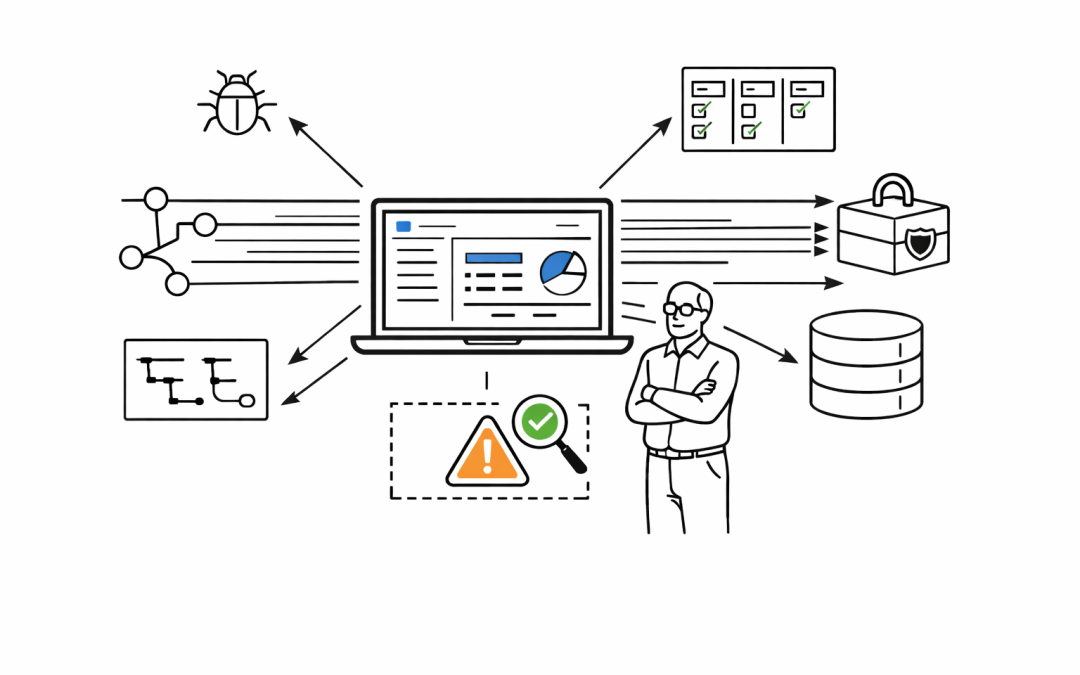
GitHub’s new Copilot app is designed to solve that coordination problem. Its My Work view gives teams a single place to see active sessions, issues, pull requests, and background automations across connected repositories. Each session runs in its own isolated git worktree, which means multiple agents can work in parallel without stepping on each other.
That matters because delegation only works when the delegated work is visible, bounded, and reviewable.
What Senior Developers Can Now Delegate
The practical shift is that senior developers no longer need to spend their time personally driving every intermediate step between issue and pull request.
With the Copilot app, an engineer can dispatch an agent to investigate a production bug, hand another agent a backlog issue, and let a third work through pull request feedback in parallel. GitHub is also extending this beyond interactive sessions. Copilot cloud agent can now run automations on a schedule or when repository events occur, such as new issues or pull request updates.
That opens up a new delegation layer for teams.
Senior developers can increasingly hand off bounded execution work such as triaging issues, preparing draft fixes, addressing low-risk review comments, generating release notes, or attempting routine maintenance tasks like fixing failing tests overnight. They can also use Agent Merge to let Copilot monitor CI, track reviewers, respond to failing checks, and merge only when the predefined conditions are met.
This is not junior-developer replacement. It is workflow compression. Work that previously required a senior engineer to manually shepherd every step can now be supervised instead of individually performed.
What Still Should Not Be Delegated
The arrival of an agent desktop does not remove the need for engineering judgment. It raises the value of it.
Senior developers should not delegate architectural trade-offs, trust-boundary decisions, production-risk calls, or policy exceptions. Those are decisions about intent, accountability, and business exposure. An agent can propose options, gather evidence, and execute within a policy. It should not invent the policy.
This is where many organisations will get the model wrong. They will see faster output and assume they can remove senior review from the loop. In practice, the opposite is true. The more work agents perform, the more important it becomes that experienced engineers define guardrails, inspect results, and decide what is acceptable.
GitHub Is Building the Missing Control Layer
What makes this announcement more important than a simple UI launch is the supporting control plane GitHub released around it.
GitHub’s new canvases give developers a shared work surface where plans, browser sessions, terminals, deployments, and workflow state can be inspected and redirected. Cloud and local sandboxes provide isolated execution environments. Local sandboxing restricts filesystem, network, and system access on the developer machine, while cloud sandboxes run in ephemeral Linux environments governed by organisational policy.
GitHub also expanded the review and extensibility layers around agent output. Copilot code review now includes a medium review tier that routes pull requests to a higher-reasoning model for better precision and recall. Teams can shape review behaviour through custom agent skills, MCP server connections, and configurable actions workflows.
At the same time, the Copilot SDK is now generally available across Node.js, Python, Go, .NET, Rust, and Java. That gives internal platform teams a stable way to build their own tools and workflows on the same agent runtime, with features such as prompt customisation, tool registration, multi-client sessions, and OpenTelemetry tracing.
Taken together, that means GitHub is no longer just selling an assistant. It is offering a managed environment for agent-native development.
The Real Change Is Managerial, Not Technical
For Australian organisations, especially mid-market firms trying to modernise delivery without losing control, the key question is not whether developers will use agents. They already are.
The real question is whether the organisation has a delegation model for agent work. Which tasks can an agent perform without approval? Which tasks require a human checkpoint? Which repositories can use higher-autonomy workflows? Which tools can an agent access? Which model tier is acceptable for low-risk versus high-impact code?
GitHub’s announcement makes those questions unavoidable. The platform now supports a world where agent work is persistent, parallel, and increasingly operationalised.
Organisations that respond well will treat senior developers less as individual code producers and more as system designers for human-plus-agent delivery. Their role becomes setting intent, defining policies, reviewing outcomes, and stepping in where judgment matters most.
Why This Matters Now
This is one of the clearest signs yet that AI coding agents are moving from novelty to infrastructure. GitHub would not be building a dedicated desktop control centre, isolated sandboxes, scheduled automations, and a general-availability SDK if it believed agentic development was a side feature.
For business leaders, that means software productivity discussions need to mature quickly. The competitive edge will not come from giving every developer an AI assistant. It will come from deciding what can be delegated, what must be governed, and how senior engineering attention is used where it creates the most leverage.
GitHub’s new agent desktop does not eliminate the need for senior developers. It makes their judgment more strategic.
CPI Consulting helps Australian organisations put governance, security, and operating models around AI-assisted software delivery. If your team is deciding what AI coding agents should automate and what should stay under human control, speak with our team about building a practical delegation framework.