
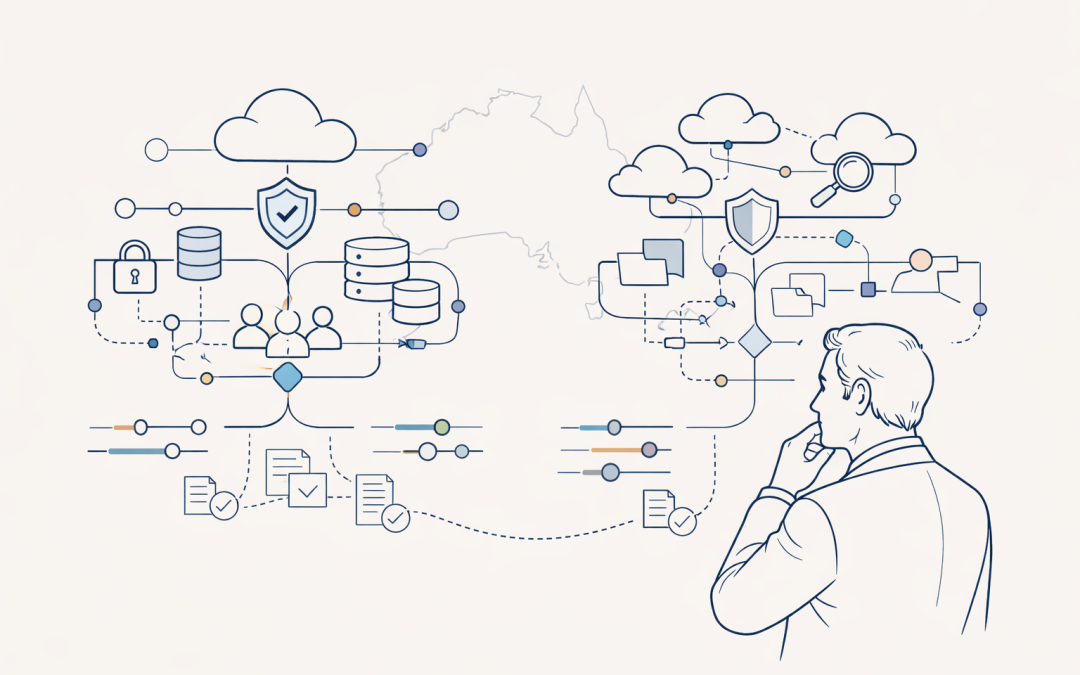
Claude Fable 5 gives Australian technology leaders another reason to revisit their enterprise AI architecture.


The question is not simply whether the model is powerful enough. For most CIOs, CTOs and IT managers, the harder question is where the model should run, who governs it, how usage is controlled, and how quickly the organisation can move from experimentation to production.
For teams already invested in Microsoft, Microsoft Foundry may look like the natural path. For teams that want direct model access, faster experimentation, or tighter alignment with Anthropic’s native tooling, Anthropic’s own platform may be attractive.
Both paths can be valid. The important point is that they are not operationally identical.
Australian organisations should compare Claude Fable 5 across Microsoft Foundry and Anthropic before committing serious workloads, budgets, or internal operating models.
The business problem is not model access
Many organisations are past the first stage of AI adoption.
They have trialled chat assistants. They have tested code generation. They have run proof-of-concepts for summarisation, document analysis, customer service, internal knowledge search, and software engineering support.
The next stage is more difficult.
CIOs now need to answer questions such as:
- Who can use frontier AI models inside the business?
- Which data is allowed to leave internal systems?
- How are prompts, outputs, logs, and audit records retained?
- How are model costs allocated to teams or business units?
- How are AI agents monitored when they perform multi-step tasks?
- What happens when a model refuses, escalates, or falls back because of safety controls?
- How does the platform align with Australian privacy, cyber security, and governance expectations?
Claude Fable 5 is important because it is positioned for more complex reasoning, coding, document-heavy workflows, visual analysis, and longer-running agentic tasks.
That means it is more likely to be used in workflows that affect production systems, regulated data, internal processes, customer experience, and operational risk.
This is where the platform choice matters.
Why Microsoft Foundry is attractive for Australian enterprises
For many Australian mid-market and enterprise organisations, Microsoft is already the centre of gravity.
Identity is in Microsoft Entra ID. Devices are managed through Microsoft Intune. Security operations may already depend on Microsoft Defender XDR and Microsoft Sentinel. Data, applications, and collaboration often sit across Microsoft 365, Azure, Power Platform, GitHub, Dynamics, and SQL workloads.
In that environment, Microsoft Foundry can make Claude Fable 5 easier to place inside an enterprise control plane.
The main advantages are practical rather than theoretical.
1. Identity and access control
A CIO should ask whether Claude Fable 5 access can be governed using the same identity, conditional access, privileged access, and role-based access patterns already used elsewhere.
If Microsoft Foundry allows teams to align model access with Entra ID groups, enterprise policies, and existing operational processes, that can reduce friction.
This matters for Australian organisations that need clear accountability across internal users, developers, contractors, and external partners.
2. Security monitoring and operational visibility
AI usage should not become an unmanaged side channel.
If Claude Fable 5 is consumed through a Microsoft environment, organisations may have a better path to centralised logging, monitoring, policy enforcement, and security review.
That does not remove the need for AI-specific controls. It does, however, make it easier to include AI activity in existing governance conversations.
For security-conscious organisations, this should connect back to ACSC guidance, Essential Eight maturity, incident response planning, and internal risk management.
3. Agent governance
Claude Fable 5 is not only relevant for simple chat.
The bigger opportunity is in agentic workflows: code review, test generation, document processing, data analysis, operational runbooks, research tasks, and multi-step business processes.
These workflows need guardrails.
CIOs should assess how Microsoft Foundry handles:
- Agent deployment approvals
- Tool and connector permissions
- Environment separation between development, test, and production
- Human-in-the-loop review
- Logging of actions taken by agents
- Rollback and incident handling
- Cost and quota controls
For many organisations, the risk is not that the model gives a bad answer once. The risk is that an automated workflow performs the wrong action repeatedly or at scale.
4. Procurement and billing alignment
Another advantage of Microsoft Foundry may be commercial simplicity.
If usage can be managed through existing Microsoft commercial arrangements, marketplace billing, cost management, and internal chargeback processes, finance and procurement teams may find it easier to support production adoption.
This is not a small issue.
AI adoption often stalls because business units experiment faster than finance, security, and architecture teams can govern spend.
A platform that fits existing cost management workflows can reduce this risk.
Why direct Anthropic access may still be the right choice
Microsoft Foundry will not be the best path for every workload.
Direct access to Anthropic may be better where teams need the fastest access to Anthropic-native capabilities, model documentation, prompt engineering patterns, evaluation tools, or platform-specific controls.
It may also suit organisations that are not Microsoft-centric or that are building multi-cloud and vendor-neutral AI platforms.
1. Faster model experimentation
AI teams often want to test new model behaviours quickly.
Direct Anthropic access may provide a cleaner path for experimentation with model parameters, prompting patterns, evaluation workflows, and application design.
For product teams, research teams, and advanced engineering groups, this can matter.
The question is whether the speed advantage is worth the additional governance work.
2. Native model behaviour and documentation
When evaluating a new model, teams often want to understand how it behaves in its native environment before routing it through another platform.
This can help teams compare:
- Prompt formats
- Tool use patterns
- Refusal behaviour
- Safety fallbacks
- Latency
- Output consistency
- Long-running workflow behaviour
- Cost per task, not only cost per token
This kind of evaluation is especially important for Claude Fable 5 because it is designed for more capable, longer-running work.
A small difference in output quality, context handling, or tool behaviour can have a large effect in production.
3. Multi-cloud flexibility
Some Australian organisations deliberately avoid becoming too dependent on one cloud ecosystem.
They may have workloads across Azure, AWS, Google Cloud, SaaS platforms, and on-premises systems.
In that context, direct Anthropic access may help support a more portable model access layer.
This can be useful if the organisation wants to build an internal AI gateway that routes requests across multiple models, vendors, regions, and business policies.
The Australian governance lens
Australian CIOs should evaluate Claude Fable 5 through a local governance lens, not only a technology lens.
That includes privacy, cyber security, regulatory exposure, contractual obligations, data classification, and operational resilience.
Key questions include:
- Are prompts and outputs treated as business records?
- What data retention rules apply?
- Can sensitive customer, employee, health, financial, legal, or operational data be used?
- Are logs available for audit, investigation, and compliance review?
- How are offshore processing and data residency handled?
- Does the platform support the organisation’s privacy obligations?
- How does the platform align with cyber insurance requirements?
- Can the organisation demonstrate reasonable controls if an AI-related incident occurs?
For many Australian businesses, AI governance should sit beside existing cyber and risk frameworks.
The Essential Eight does not directly solve AI governance, but it does provide a useful discipline: know your systems, restrict access, patch weaknesses, monitor activity, and prepare for compromise.
The same mindset should apply to AI platforms.
Compare cost by business outcome, not token price only
Claude Fable 5 pricing and consumption models will matter, but CIOs should avoid comparing platforms only by headline token rates.
A better approach is to measure cost per completed business outcome.
For example:
- What is the cost to process 10,000 supplier contracts?
- What is the cost to migrate a legacy code module and generate tests?
- What is the cost to classify and summarise a month of support tickets?
- What is the cost to run an internal research agent across approved data sources?
- What is the cost to support a developer team for a sprint?
This approach captures the real economics.
A cheaper model path can become more expensive if it requires more retries, more engineering work, weaker observability, manual review, or separate governance tooling.
Likewise, a more expensive platform can be justified if it reduces risk, shortens implementation time, or makes compliance easier.
Build a comparison matrix before production adoption
Before selecting a default path, CIOs should run a structured comparison.
A practical matrix should include:
| Evaluation area | Microsoft Foundry | Anthropic direct | | — | — | — | | Identity and access | Alignment with Microsoft identity and access controls | Platform-specific access and API key governance | | Security monitoring | Potential integration with Microsoft security operations | Requires direct logging and monitoring design | | Data governance | Fit with Azure governance and enterprise controls | Requires separate policy mapping and controls | | Agent orchestration | Useful where Microsoft ecosystem integration is central | Useful where native model control or custom orchestration is preferred | | Developer experience | Strong for teams already using Azure and GitHub | Strong for teams wanting Anthropic-native APIs and documentation | | Procurement | May align with existing Microsoft procurement | Separate vendor and commercial management | | Portability | Strong inside Microsoft environments | Potentially stronger for vendor-neutral architectures | | Compliance evidence | May fit existing audit processes | Requires deliberate evidence collection | | Cost management | May align with Azure cost management practices | Requires separate cost tracking and allocation | | Time to production | Faster for Microsoft-standardised environments | Faster for advanced AI teams already using Anthropic |
The winning option may differ by workload.
A Microsoft-heavy internal productivity agent may fit Foundry. A product engineering team building a model-agnostic AI service may prefer direct Anthropic access. A regulated workflow may require both options to go through an internal AI gateway.
Do not skip evaluation and red teaming
Claude Fable 5 should be tested against real business workflows before broad deployment.
Australian organisations should evaluate:
- Accuracy on local business documents
- Behaviour with Australian terminology and compliance language
- Performance on internal coding standards
- Handling of sensitive or regulated data
- Refusal and fallback behaviour
- Prompt injection resistance
- Tool-use safety
- Hallucination risk
- Auditability
- Human review requirements
This should not be a one-off technical test.
Security, architecture, legal, privacy, risk, finance, and business owners should all have input before production use.
For agentic workflows, the testing bar should be higher. Any AI system that can call tools, write code, change data, trigger workflows, or interact with business systems needs stronger approval and monitoring than a simple chat interface.
A sensible adoption pattern
For most organisations, the safest path is not to choose blindly between Microsoft Foundry and Anthropic.
A better pattern is:
- Define approved Claude Fable 5 use cases.
- Classify the data involved in each use case.
- Test the same prompts and workflows through Microsoft Foundry and Anthropic.
- Compare quality, latency, cost, logging, safety behaviour, and operational effort.
- Decide which workloads require Microsoft-native governance.
- Decide which workloads benefit from Anthropic-native access.
- Put usage behind an internal AI policy, gateway, or approved application layer.
- Monitor spend, incidents, output quality, and user behaviour continuously.
This gives CIOs flexibility without creating unmanaged AI sprawl.
The decision is architectural
Claude Fable 5 may help organisations move from AI experiments to more capable AI-assisted work.
But for Australian CIOs, the model is only one part of the decision.
The real decision is architectural.
Microsoft Foundry may be the stronger option where enterprise governance, Microsoft ecosystem integration, identity, security monitoring, and procurement alignment are the priority.
Direct Anthropic access may be stronger where teams need native model access, faster experimentation, portability, or a vendor-neutral AI platform strategy.
The right answer may be both, with clear rules for when each path is used.
Before scaling Claude Fable 5, Australian organisations should compare platforms carefully, document the decision, and make sure AI adoption does not outrun governance.
If your organisation is evaluating Claude Fable 5 across Microsoft Foundry and Anthropic, our team can help assess the architecture, governance model, security controls, and implementation path before production rollout.