
In this blog post How Sandbox Agents Improve Code Review and Website Prototypes we will explain how businesses can speed up software reviews and turn website ideas into working previews without giving AI uncontrolled access to important systems.
The problem is familiar. Developers wait for code reviews, marketing teams struggle to explain website changes in documents, and senior technical staff spend valuable time checking routine work. AI can help, but allowing an AI agent to run commands directly on a developer’s laptop or production server creates a new and unnecessary risk.
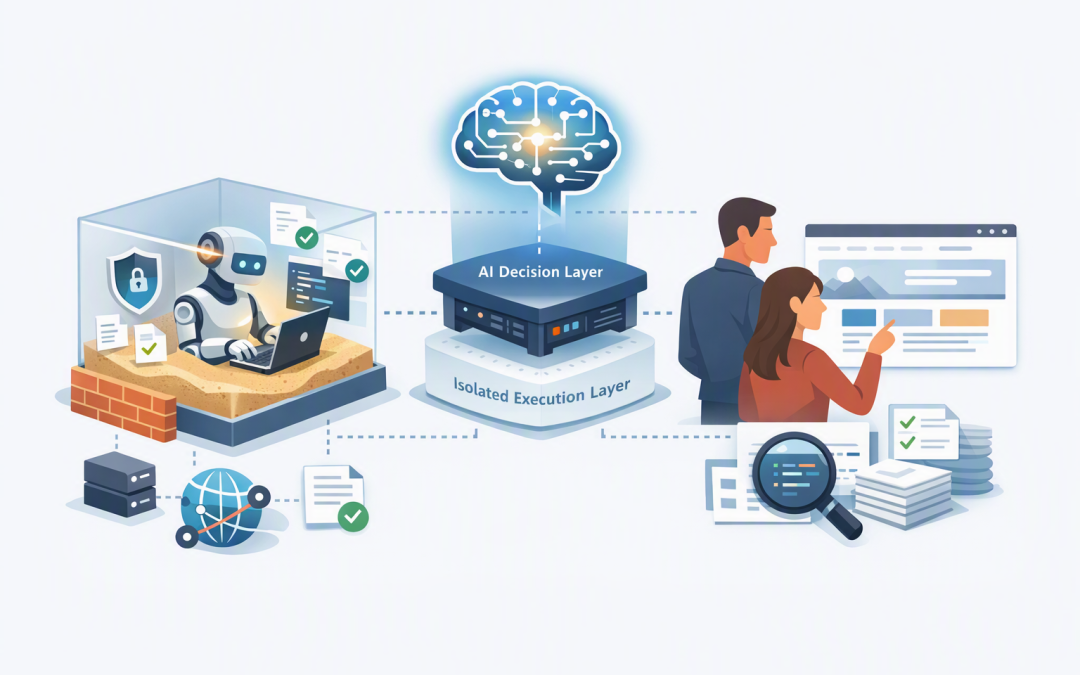
A sandbox agent solves this by giving the AI a temporary, isolated workspace. Think of it as a secure project room containing only the files, tools and permissions required for one task. The agent can inspect code, run approved tests and build a website preview, but it cannot simply wander through the rest of your business environment.
What is the technology behind a sandbox agent?
A sandbox agent combines an AI model, such as OpenAI Codex or Anthropic Claude, with a controlled computing environment. The AI decides what steps to take, while the sandbox provides a limited place in which those steps can be carried out.
Inside that workspace, the agent may have a copy of a code repository, approved software packages, testing tools and a temporary web server. Access to company networks, credentials and production data can be blocked or tightly limited.
The technology generally has two separate parts:
- The decision layer, which interprets the task, creates a plan and decides which tools to use.
- The execution layer, which runs commands and changes files inside the isolated sandbox.
This separation matters. If the agent makes a poor decision, its ability to cause damage is restricted by the sandbox. For a broader explanation of this security model, see when your business AI agent needs a secure sandbox.
How sandbox agents improve code review
Code review often becomes a bottleneck because experienced developers are asked to check everything. That includes important design decisions, but also routine issues such as missing tests, inconsistent formatting, outdated packages and incomplete documentation.
A sandbox agent can perform the first review pass. It can open a proposed change, examine the affected files, install approved dependencies and run automated checks in its temporary environment. It can then produce a structured review for a human developer.
For example, the agent might be asked to:
- Identify changes that could expose customer or employee data.
- Run existing tests and report any failures.
- Look for missing error handling or access checks.
- Compare the change against internal coding standards.
- Suggest additional tests without approving its own work.
GitHub’s cloud agents use temporary development environments to inspect repositories, make changes and run tests before presenting work for review. The important business control is that the result remains a proposed change rather than an automatic production release.
This does not replace your senior developers. It allows them to focus on questions that require judgement, such as whether the change supports the business requirement and whether the design will remain maintainable.
Teams wanting several specialised review passes can build on the approach covered in parallel code review with GitHub Copilot CLI. One agent can check security, another can examine testing, and another can look for unnecessary complexity.
Turning website ideas into working prototypes
Website projects often lose time before development even begins. A business leader describes a new landing page, someone creates a document or static design, and the development team tries to interpret what everyone meant.
A sandbox agent can turn a written brief into a working prototype. It can create the page structure, add placeholder content, apply approved brand styles and launch a temporary preview that stakeholders can open in a browser.
Because the prototype runs inside the sandbox, it does not need access to the live website. It can use test content rather than real customer information, and the environment can be deleted when the review is complete.
This gives decision-makers something concrete to assess. Instead of debating whether a button should be “more prominent,” they can see it, test it and request a change.
The business outcome is less rework. Developers receive clearer feedback earlier, while marketing and operations teams can validate the customer journey before time is spent building production integrations.
What safe implementation looks like
A sandbox should not be treated as a licence to let an agent do anything. The safest approach is to begin with the minimum access required for the task and expand it only when there is a clear business reason.
A simple policy might look like this:
task: website-prototype
repository: marketing-website
filesystem:
 read: repository
 write: temporary-workspace
network:
 allow: approved-package-registry
secrets: none
human_approval_required_before:
 - merging-code
 - publishing-website
 - accessing-production
maximum_runtime: 60-minutes
This is a conceptual example rather than configuration for a specific product. It shows the decisions every organisation should make before an agent begins work.
Use one sandbox for each task
Do not allow unrelated projects to share the same working environment. Separate sandboxes reduce the chance of files, instructions or credentials moving between projects.
Keep production access out by default
Most code reviews and prototypes do not require access to production systems. If production access is genuinely needed, it should require explicit approval, limited credentials and detailed logging.
Control internet access
An agent may need to download an approved software package, but that does not mean it needs unrestricted internet access. Allow only the destinations required for the job.
Record what the agent did
Keep the task instructions, commands, file changes, test results and approvals. This gives your team an audit trail and makes unsuccessful runs easier to diagnose.
Require a human release decision
The agent can prepare work, but an accountable person should approve merges, deployments and publication. This principle also applies when using the workflows described in the OpenAI Codex app for faster secure code.
A practical business scenario
Consider a 180-person professional services company with a small internal development team. Its senior developer regularly loses several hours reviewing routine website updates, while marketing waits days to see whether campaign page ideas will work.
The company introduces two tightly controlled sandbox workflows. The first reviews proposed code changes and produces a report covering test results, security concerns and missing documentation. The second creates temporary website previews from approved briefs and brand components.
Marketing can now review a working page before the development team connects forms, analytics or customer systems. The senior developer still makes the final decision, but starts with tested code and a structured review rather than a blank screen.
The result is not simply “more AI.” It is faster feedback, fewer review delays and less expensive rework, with production access remaining outside the agent’s control.
How this supports Australian security expectations
Sandboxing does not automatically make an organisation compliant with the Essential Eight, the Australian government’s cybersecurity framework that many organisations use as a security baseline.
However, a properly controlled sandbox supports the same risk-reduction thinking. In particular, it can limit administrative privileges and restrict which applications, scripts and commands are allowed to run. These are important parts of the Essential Eight approach.
Source code and prototype data also need classification. Customer records, production passwords and confidential commercial information should not be copied into a sandbox simply because the environment is temporary.
Start with a narrow pilot
The best first project is repetitive, measurable and low risk. Good examples include reviewing documentation changes, checking test coverage or building a temporary landing page with placeholder data.
Measure review turnaround time, defects found before release, developer hours spent on routine checks and the number of prototype revisions. This will tell you whether the investment is producing a real business benefit.
CloudPro Inc combines more than 20 years of enterprise IT experience with practical work across Azure, Microsoft 365, OpenAI, Claude, Microsoft Defender and Wiz. As a Melbourne-based Microsoft Partner and Wiz Security Integrator, we help organisations design agent workflows that are useful without weakening existing security controls.
If you are considering sandbox agents for code review or website prototyping but are unsure how much access they should receive, we are happy to review the proposed setup and help you identify a safe, practical starting point — no strings attached.
Discover more from CPI Consulting
Subscribe to get the latest posts sent to your email.