
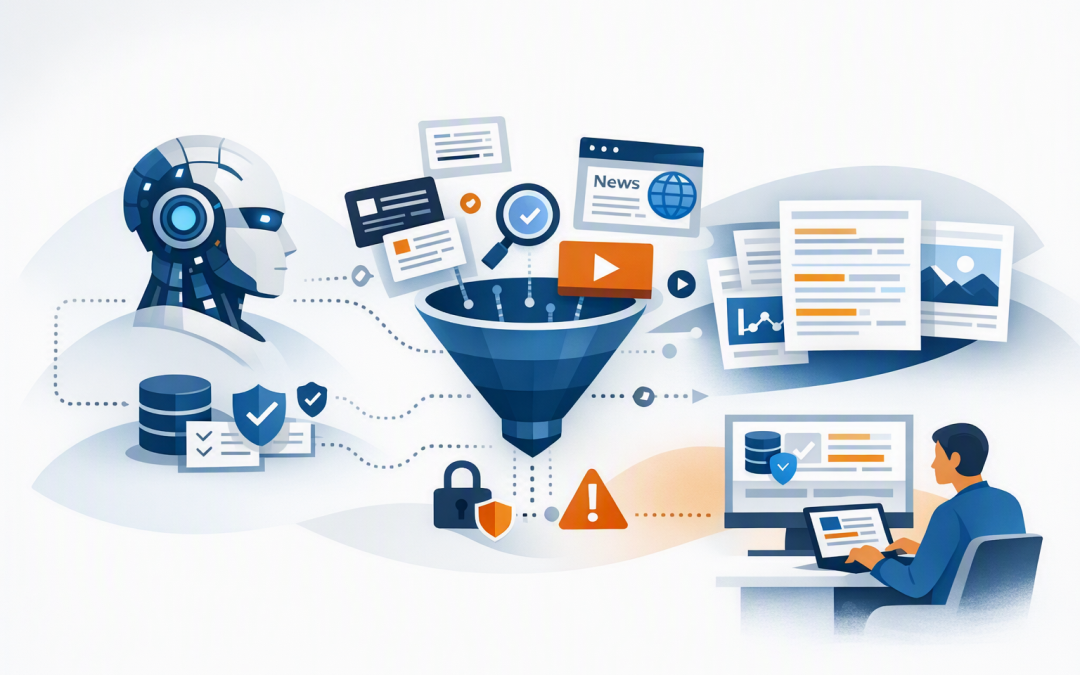
In this blog post How Web IQ Gives Business AI Agents Trusted Live Web Information we will explain how organisations can give AI agents access to current external information without turning them into uncontrolled web browsers.
This matters because many business AI tools have a hidden weakness. They can write polished answers, but the information behind those answers may be months old, incomplete or disconnected from what is happening in the market today.
Microsoft Web IQ addresses that problem by giving AI agents a structured way to search the web, retrieve relevant evidence and use it when answering a question. In plain English, it helps an agent check current information before it responds.
Why normal AI answers can quickly become outdated
Large language models such as OpenAI and Anthropic Claude learn from large collections of information. However, the model does not automatically know about every new regulation, product update, supplier announcement, security threat or market change.
This creates a business risk. An answer can sound confident while being based on information that is no longer correct.
Consider an operations director asking an AI agent to compare current shipping conditions, supplier announcements and internal stock levels. The model may understand logistics, but it cannot give a dependable answer unless it can also retrieve current external information.
Web IQ provides that external layer. It complements internal knowledge systems rather than replacing them.
For example, Azure AI Search Knowledge Sources can help an agent find trusted information inside company documents. Web IQ can add relevant information from current web pages, news, images and videos.
What Web IQ actually does
Web IQ is a Microsoft service designed specifically for AI applications and agents. Instead of returning a page of search results for a person to open, it returns ranked passages and structured information that an AI model can use directly.
This process is called grounding. Grounding simply means giving the AI relevant evidence before it creates an answer, reducing the chance that it will guess or rely only on what it learned during training.
The difference is important. A traditional search engine helps a person locate documents, while Web IQ helps an AI system locate the specific information it needs to complete a task.
Web IQ can expose tools for searching web pages, news, images and videos, as well as retrieving information from a specific page. The agent can choose the appropriate tool based on the question it has been asked.
How the technology works behind the scenes
A typical Web IQ workflow has five stages.
- A user asks a business question. For example, “Have any of our major suppliers announced delivery delays this week?”
- The agent decides whether current web information is required. It should not search externally when an answer can be produced safely from approved internal information.
- The agent sends a search request to Web IQ. This can happen through an application programming interface, which is a controlled connection between software systems, or through Model Context Protocol.
- Web IQ retrieves and ranks relevant evidence. It can return focused passages instead of sending entire web pages into the AI model.
- The agent prepares an answer. It combines the external evidence with approved internal information, applies business rules and presents the result to the user.
Model Context Protocol, commonly called MCP, is a standard way for AI agents to connect to tools and information services. Think of it as a common plug that allows an agent to use Web IQ without every development team creating a completely different connection.
A simplified configuration might look like this:
{
 "tool": "Web IQ",
 "connection": "MCP",
 "authentication": "Microsoft Entra ID",
 "allowed_actions": [
 "search_web",
 "search_news",
 "retrieve_page"
 ],
 "human_approval_for_actions": true
}
This example is intentionally high level. A production configuration must also cover identity, logging, content filtering, source rules, spending limits and what the agent is permitted to do with the answer.
The business value is faster research, not more AI
The goal is not to give employees another chatbot. The goal is to reduce the time spent manually gathering, checking and summarising information.
Current answers improve decision quality
Web access is useful for questions involving changing information. Common examples include competitor announcements, software updates, public tenders, supplier news, product availability, regulatory developments and newly disclosed security threats.
Giving an agent access to current evidence can help executives make decisions using this week’s information rather than last quarter’s assumptions.
Focused passages can control AI costs
Sending entire web pages to an AI model is slow and wasteful. Web IQ can return the passages most relevant to the question, reducing the amount of text the model must process.
AI services often measure usage in tokens, which are small chunks of text. Processing fewer irrelevant tokens can reduce response times and operating costs, particularly when an agent performs several searches to complete one task.
Teams spend less time assembling reports
Imagine a 200-person distribution company where eight managers each spend one hour a week checking supplier updates, industry news and market conditions. That adds up to more than 400 staff hours a year before anyone acts on the findings.
A controlled agent could gather the relevant updates, compare them with internal stock or customer information and prepare a weekly briefing. Managers would review the evidence and make the decision, but the repetitive research work would be substantially reduced.
This builds on the approach discussed in connecting Microsoft Foundry agents to business systems. Internal connections explain what is happening inside the organisation, while Web IQ can add what is happening outside it.
Live web access also introduces new risks
The public web is not a trusted business database. It contains inaccurate information, outdated pages, biased commentary and content deliberately designed to manipulate AI systems.
One concern is indirect prompt injection. This is where a web page contains hidden or misleading instructions intended to make an AI agent ignore its rules, expose information or perform an unauthorised action.
For this reason, a web-enabled agent should never receive unrestricted access to email, files, finance systems or customer records. Reading external information and performing internal actions should be treated as separate levels of risk.
Practical controls include:
- Use Microsoft Entra ID, Microsoft’s identity and access platform, to give every production agent a controlled identity.
- Apply least privilege so the agent receives only the access required for its specific job.
- Keep web research tools read-only wherever possible.
- Require human approval before sending messages, changing records, placing orders or publishing content.
- Use content safety controls to detect malicious instructions hidden in web pages.
- Keep logs showing what the agent searched, which evidence it used and what action followed.
- Set usage and spending limits to prevent uncontrolled search loops.
Our article on securing AI agent identities with Microsoft Entra ID explains why agents need clear ownership, limited permissions and an audit trail.
What Australian organisations should check first
Australian businesses should review where search queries, retrieved content, prompts and logs are processed or stored. Sensitive customer, employee or commercial information should not be included in external searches without a clear business reason and appropriate privacy controls.
Web IQ does not automatically make an AI solution compliant. Organisations still need governance covering the Australian Privacy Principles, contractual confidentiality, data retention and industry-specific requirements.
The Essential Eight, the Australian Government’s baseline cybersecurity framework, also remains relevant. Controls such as multi-factor authentication, patching, restricted administrator access and regular backups help protect the broader environment in which the agent operates.
Because Web IQ is a developing service, organisations should also confirm current feature availability, regional processing arrangements, service terms and production support before depending on it for critical workflows.
Start with one controlled business question
The best starting point is not “give our AI access to the internet.” It is a narrow question such as “prepare a daily summary of supplier disruption notices” or “monitor public security advisories affecting our approved software.”
Define the approved sources, expected output, human reviewer and measurable outcome. Then test accuracy, cost and security before expanding the agent’s responsibilities.
As a Microsoft Partner and Wiz Security Integrator with more than 20 years of enterprise IT experience, CloudProInc helps organisations connect AI services to Azure, Microsoft 365 and security controls without losing sight of the business outcome. Our Melbourne-based team takes a practical, hands-on approach rather than treating AI as a generic software rollout.
If you are considering live web access for a business AI agent and are not sure where the security boundary should sit, we are happy to review the proposed use case and help you identify a safe, useful place to start.
Discover more from CPI Consulting
Subscribe to get the latest posts sent to your email.