
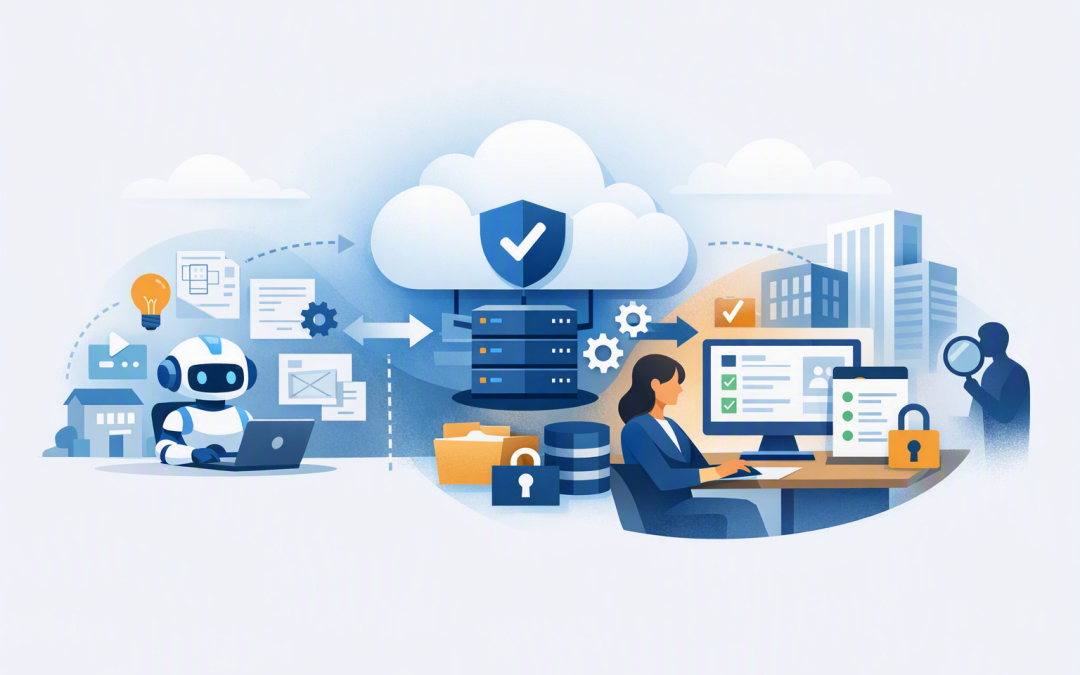
In this blog post Why Hosted Agents Make Production AI Easier for Small Businesses we will explain how managed hosting can remove one of the biggest barriers to useful AI. Many businesses can build an impressive prototype, but then discover that keeping it secure, reliable and affordable requires far more work than expected.


A hosted agent solves part of that problem by giving your AI agent a managed place to run. Instead of your team building and maintaining every server, security control and monitoring component, a platform such as Microsoft Foundry Agent Service handles much of the operational foundation.
This does not make production AI effortless. You still need a clear business process, appropriate data access, testing and governance. However, it can turn a complicated infrastructure project into a more manageable business application.
What is a hosted AI agent
An AI agent is software that uses an AI model to understand a request, decide what steps to take and complete a task. Unlike a basic chatbot, an agent may also retrieve company information, update a business system or ask a person to approve an action.
For example, an accounts agent could read an emailed invoice, check the supplier against your finance system, identify missing information and prepare the transaction for approval. The AI handles interpretation, while your business rules determine what it is allowed to do.
A hosted agent is that application running inside a managed cloud environment. Microsoft manages the runtime, meaning the underlying environment where the software operates, while your development team controls the agent’s instructions, tools, workflow and permissions.
Hosted agents can generally be deployed as source code or as a container. A container is simply a packaged version of the application that includes what it needs to run consistently across development, testing and production environments.
How the technology works behind the scenes
At a high level, a hosted agent sits between your users, an AI model and the business systems needed to complete the task. A typical request follows a controlled sequence.
- A user or application sends a request. This might come from an internal portal, Microsoft Teams, a customer application or another approved channel.
- The platform creates an isolated session. The conversation and working information are separated so one user’s activity does not become mixed with another’s.
- The agent calls an AI model. The model interprets the request and helps determine the next appropriate step.
- The agent uses approved tools. These are controlled software connections to systems such as Microsoft 365, a CRM, a service desk or an internal database.
- The activity is recorded. Logs and traces show what happened, how long it took and where a failure occurred.
The agent’s custom code still controls the workflow. The hosted platform takes responsibility for much of the supporting infrastructure, including deployment, session management, identity, scaling and operational monitoring.
This distinction matters. As discussed in our guide to Azure Foundry prompt agents versus hosted agents, prompt agents suit simpler use cases, while hosted agents provide greater control when the workflow requires custom code or more complex business logic.
Why hosting is often the hidden AI problem
Most small and mid-sized businesses do not have a dedicated AI operations team. The same IT staff may already be responsible for Microsoft 365, cybersecurity, devices, cloud costs, user support and compliance.
Building an agent is therefore only part of the challenge. Someone must also keep it available, install updates, manage identities, investigate failures, control costs and make sure it does not expose sensitive information.
Traditional hosting can require several separate cloud services, security settings and monitoring tools. Each component adds configuration work and creates another place where an error can occur.
Hosted agents reduce this infrastructure burden by providing a standard operating environment. Your team can spend more time improving the business process and less time maintaining the plumbing underneath it.
Five business benefits of hosted agents
1. Faster movement from pilot to production
A prototype running on a developer’s laptop proves that an idea is possible. It does not prove that the agent can support real users safely every day.
Hosted deployment creates a clearer path between development, testing and production. That can shorten delivery time and reduce the chance of a promising pilot becoming permanently stuck in testing.
For a deeper look at the planning involved, see how to move AI agents from prototype to production without chaos.
2. Less infrastructure to maintain
The hosting platform manages many routine operational tasks. It can start additional capacity when demand increases and reduce capacity when usage falls, rather than requiring your business to maintain oversized infrastructure all day.
This can lower administration effort and avoid paying continuously for computing capacity that is rarely used. Model usage, storage, networking and related Azure services still need to be budgeted, so cost monitoring remains important.
3. Stronger identity and access control
A production agent should never receive broad access simply because that is easier during development. It should have its own managed identity, which is a secure digital identity that allows the application to access only approved resources without storing passwords in its code.
That supports least-privilege access, meaning the agent receives only the permissions needed for its specific job. If it prepares service tickets, for example, it should not automatically receive permission to change payroll records.
4. Better visibility when something goes wrong
AI failures are not always obvious. An agent may produce a poor response because it received incomplete data, selected the wrong tool or followed an instruction in an unexpected way.
Hosted platforms can provide logs, performance information and end-to-end traces. In plain English, this gives your team a record of the steps the agent took, making problems easier to investigate and fix.
5. More choice without rebuilding everything
A hosted agent can keep the workflow in your own code while using an appropriate AI model for reasoning. This makes it easier to change models or frameworks as requirements evolve, provided the solution has been designed with that flexibility in mind.
CloudProInc works across Microsoft Foundry, Azure OpenAI and Anthropic Claude because the best model depends on the task, risk profile, data requirements and budget. Model choice should be a business decision, not a permanent commitment made during an early pilot.
A practical small-business scenario
Consider a 120-person professional services firm receiving hundreds of client and supplier emails each week. Staff manually classify each message, find the relevant account, create a task and forward it to the correct team.
The business builds an agent that can interpret the email and prepare the task. The prototype works, but production introduces harder questions. How will it authenticate to Microsoft 365? What happens during a busy Monday morning? Who can see the logs? How will the team roll back a faulty update?
Using a hosted agent allows the firm to deploy its custom workflow into a managed environment rather than building a separate hosting platform. The agent can use a controlled identity, scale with demand and provide operational records for support staff.
The business outcome is not simply that the company now has an AI agent. The outcome is less manual sorting, faster client response times and a supportable application that does not require another full-time infrastructure specialist.
What hosted agents do not solve for you
Managed hosting removes infrastructure work, but it does not automatically make an agent safe or valuable. Before deployment, the business still needs to answer several questions.
- What measurable problem is the agent solving?
- Which data is it permitted to read, store or change?
- Which actions require human approval?
- How will inaccurate or inappropriate outputs be detected?
- What is the acceptable cost for each completed task?
- Who is responsible when the workflow fails?
Connections to CRMs, finance platforms and service desks also need careful design. Our article about connecting Microsoft Foundry agents to business systems explains why permissions, data quality and approval controls matter as much as the AI model.
Security and compliance still need attention
For Australian organisations, hosted agents should sit inside the same security and governance program as the rest of the business. This includes considering Privacy Act obligations and the Essential Eight, the Australian Government’s cybersecurity framework for reducing common cyber risks.
A hosted agent does not make a business Essential Eight compliant by itself. However, managed identities, controlled deployment, monitoring and restricted access can support a more defensible security design.
The surrounding Azure and Microsoft 365 environment also needs protection. Microsoft Defender can help identify suspicious activity across identities, endpoints and cloud services, while Wiz can provide visibility into cloud risks and configuration weaknesses.
As a Microsoft Partner and Wiz Security Integrator, CloudProInc looks at the complete environment rather than treating the agent as an isolated application. That matters because an agent is only as secure as the systems and permissions connected to it.
A sensible way to start
Start with one narrow workflow that consumes meaningful staff time but does not create unacceptable risk. Good early candidates include classifying requests, preparing document summaries, retrieving approved internal knowledge or drafting work for human review.
Define the success measure before development begins. That might be reducing handling time by 30 per cent, shortening customer response times or removing five hours of repetitive administration each week.
Then map the data, permissions, human approvals and failure process. Build a limited version, test it with real examples and review both output quality and operating cost before increasing its authority.
Hosted agents make this process easier because the operating foundation is already available. They allow smaller businesses to adopt production AI without attempting to recreate the infrastructure and support teams of a large enterprise.
Production AI without an enterprise-sized team
The biggest advantage of hosted agents is not a single technical feature. It is the amount of operational work your business no longer has to build from scratch.
With the right use case and governance, hosted agents can reduce implementation time, improve reliability and give your team clearer control over security and costs. They provide a practical bridge between an interesting AI demonstration and a dependable business service.
CloudProInc brings more than 20 years of enterprise IT experience to Azure, Microsoft 365, AI and cybersecurity projects. We are a hands-on Melbourne consultancy serving organisations across Australia and internationally, rather than a large, faceless managed service provider.
If you have an AI prototype but are unsure how to run it securely in production, we are happy to review the architecture and identify the simplest practical next step — no strings attached.
Discover more from CPI Consulting
Subscribe to get the latest posts sent to your email.