
In this blog post Comprehensive AI Agent Protection for Identity Data and Threats we will explain how a single protection model connects identity, data controls and active threat defence, allowing AI agents to deliver business value without becoming invisible, overpowered users.


The problem often appears after a successful AI pilot. An agent that started by summarising documents is soon reading customer records, updating the CRM, creating service tickets and triggering workflows. Productivity improves, but nobody has a complete view of what the agent can access, what information it handles or how the business would stop it if something went wrong.
What comprehensive agent protection actually means
An AI agent is software that can interpret a request, make decisions and take actions through connected business systems. Unlike a standard chatbot, it may work across Microsoft 365, Azure, databases, finance platforms and customer management systems with limited human involvement.
Behind the scenes, the agent combines an AI model such as OpenAI or Anthropic Claude with instructions, memory and tools. Those tools might allow it to search SharePoint, send an email, update a record or call another application through a connector.
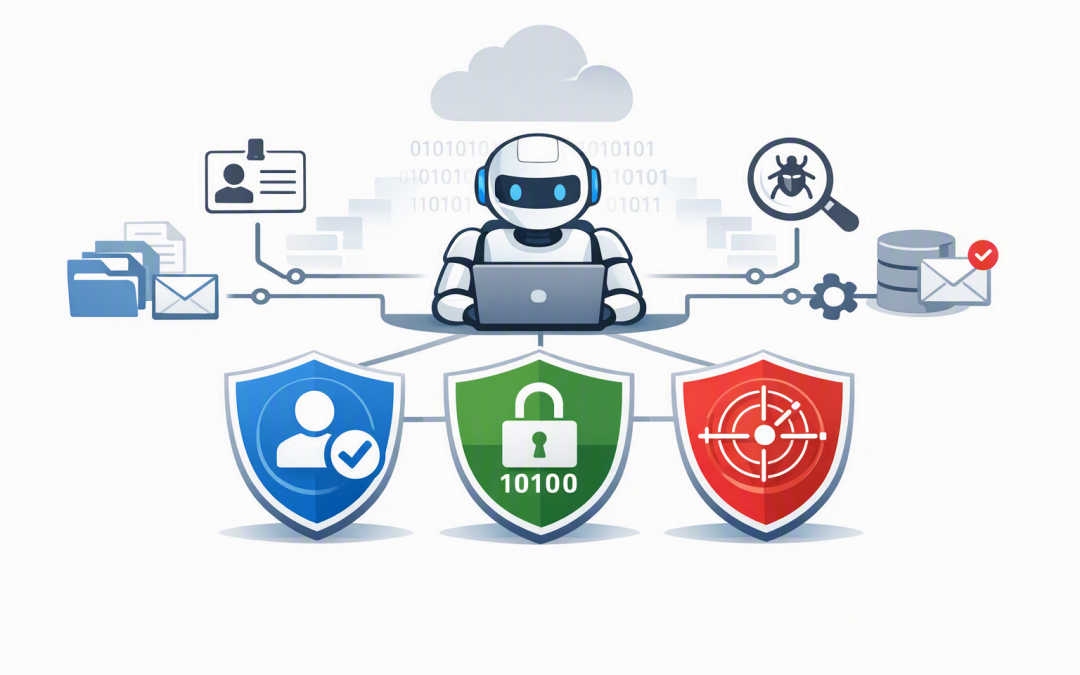
Comprehensive protection does not mean buying one security product or enabling one setting. It means operating identity, data protection and threat monitoring as one connected model. Each layer answers a different business question:
- Identity: Which agent is taking the action, who owns it and what is it allowed to do?
- Data: What information can the agent read, change, create or share?
- Threat defence: Is the agent behaving normally, or has it been manipulated, compromised or misconfigured?
If any one of these layers is missing, the business is left with a blind spot.
Identity gives every agent clear boundaries
An employee signs in with an account, receives permissions based on their role and loses access when they leave. AI agents need a similar lifecycle, but many businesses still run them through shared accounts, permanent access keys or an employee’s personal permissions.
Microsoft Entra Agent ID provides agents with their own managed identities. In plain English, each agent receives a recognisable digital identity that can be connected to an owner, limited to approved systems and included in access reviews.
This makes it possible to apply least privilege, meaning the agent receives only the access required for its job. A sales support agent might be allowed to read selected CRM records but not export the full customer database or modify financial information.
We covered the identity lifecycle in more detail in how Microsoft Entra Agent Identities secure AI agents. The important point here is that identity becomes the foundation for the other protection layers.
Business outcome: Clear identities reduce excessive access, simplify audits and make it easier to disable an agent without disrupting employees or other applications.
Data protection follows the information
Controlling access is necessary, but it is not enough. An authorised agent can still expose sensitive information if it includes payroll data in an email, sends customer details to the wrong system or uses confidential documents to answer an inappropriate request.
Microsoft Purview helps classify and protect business information. It can identify content such as personal information, financial records and commercially sensitive documents, then apply rules governing how that information may be used or shared.
For example, an agent may be permitted to summarise an internal contract while being prevented from sending the original document to an external address. This is often called data loss prevention, which simply means stopping sensitive information from leaving approved locations.
For Australian organisations, this is also a privacy issue. Agents handling customer or employee information should be assessed against the Privacy Act, relevant Australian Privacy Principles and the organisation’s own retention requirements. A privacy impact assessment may be appropriate for higher-risk uses.
Business outcome: Data controls allow teams to automate more work while lowering the risk of accidental disclosure, privacy complaints and expensive incident response.
Threat defence watches what the agent does
Even a correctly configured agent can be manipulated. A malicious instruction hidden inside a document, email or web page may attempt to change the agent’s goal. This is commonly known as prompt injection.
An attacker may also steal an agent’s credentials, misuse one of its tools or encourage it to perform a sequence of actions that appear harmless individually but create risk when combined.
Microsoft Defender brings runtime protection and investigation capabilities to supported AI agents. Runtime protection means monitoring the agent while it is operating, rather than relying only on a security review performed before launch.
Security teams can look for suspicious access, unusual tool use, unexpected data movement and behaviour that differs from the agent’s normal purpose. When identity, data and threat information are connected, investigators can see which agent acted, what it accessed and how far the incident may have spread.
Some agent security capabilities continue to evolve and may have platform, integration or licensing requirements. They should be tested against the specific mix of Microsoft, OpenAI, Claude and third-party agents in use rather than assumed to provide universal coverage.
Business outcome: Earlier detection limits the damage caused by compromised or misdirected agents and reduces the time required to understand an incident.
Why separate controls create expensive gaps
Consider a 180-person professional services firm using an AI agent to prepare project updates. The agent reads Teams conversations, SharePoint documents and customer records before drafting a weekly report.
The identity team can see its account. The compliance team can see sensitive documents. The security team can see alerts. However, if those views are not connected, nobody can quickly answer whether a suspicious report was created by the correct agent, using approved data, after receiving a manipulated instruction.
A unified model connects that evidence. The business can identify the owner, suspend access, find affected information and review related actions without manually piecing together records from several teams.
This is also why traditional user-focused security cannot simply be copied unchanged. Our article on why Zero Trust for AI agents requires a different architecture explains how machine-speed actions and tool connections change the risk.
A practical agent protection plan
Businesses do not need to redesign their entire security environment before using AI. They do need a repeatable process that applies before an agent reaches production.
- Build an agent inventory. Record every approved agent, its purpose, owner, model, tools, connected systems and expected lifespan.
- Rate the business impact. An agent that drafts meeting notes should not receive the same controls as one that changes customer, payroll or payment data.
- Assign a dedicated identity. Avoid shared accounts and permanent credentials. Give the agent minimum access and schedule regular reviews.
- Define data boundaries. Identify which information the agent may read, create, retain and send outside the organisation.
- Monitor live behaviour. Log tool calls, access attempts, blocked actions and unusual activity in a location the security team actually reviews.
- Test the stop process. Confirm that staff can suspend the agent, revoke its access and investigate its actions quickly.
Connections between agents and business systems also need strong authentication and oversight. The latest enterprise security improvements for Anthropic MCP show how safer connection standards can support this model, but good governance is still required around them.
How this supports Essential Eight maturity
The Essential Eight, the Australian Government’s baseline cybersecurity framework, was not designed specifically for AI agents. However, its principles still matter. Restricting administrative privileges, patching applications, controlling software and maintaining reliable backups all reduce the damage an agent-related incident can cause.
Agent protection should therefore extend your existing security program, not become a separate AI project. The strongest approach connects agent identities to access governance, protected data to privacy controls, and agent activity to the same incident response processes used across Microsoft 365, Azure and endpoints.
Protect the whole agent rather than one component
Securing only the AI model misses the larger risk. Most business damage will come from what an agent can access, what it can do and how quickly unusual behaviour is detected.
A comprehensive identity, data and threat defence model gives leaders a practical way to expand AI use without accepting uncontrolled access. It also creates clearer ownership, stronger audit evidence and a faster response when something does not behave as expected.
CloudPro Inc combines more than 20 years of enterprise IT experience with hands-on expertise across Microsoft Entra, Purview, Defender, Azure, Microsoft 365, OpenAI, Claude and Wiz. As a Melbourne-based Microsoft Partner and Wiz Security Integrator, we help organisations design controls that suit their real environment rather than forcing them into a generic template.
If you are not sure which agents are already connected to your business data, or whether your current controls cover identity, information and live behaviour, we are happy to take a practical look with you — no strings attached.
Discover more from CPI Consulting
Subscribe to get the latest posts sent to your email.