
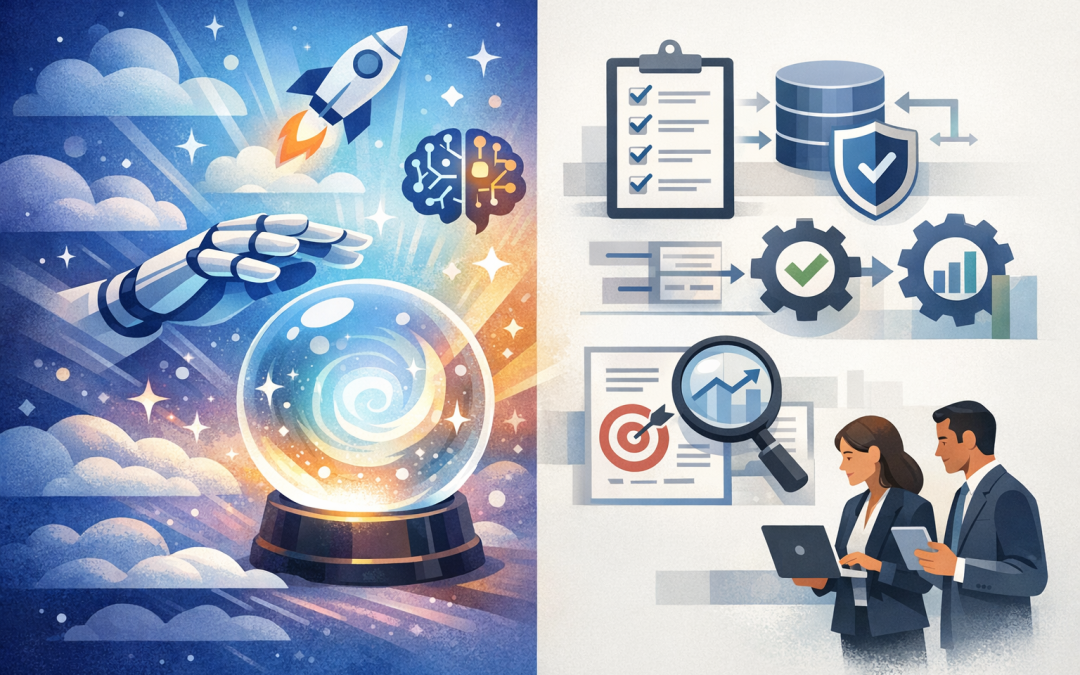
In this blog post The Difference Between AI Hype and Real Business AI Solutions we will look at how business leaders can separate exciting AI demos from practical AI systems that actually save time, reduce risk, and improve the way people work.
If you are a CIO, CTO, IT manager, or business owner, you have probably seen the pattern already. Someone in the business tries an AI tool, gets an impressive answer, and suddenly every department wants “an AI solution”.
Then the harder questions arrive. Which data can it access? Who checks the output? What happens if it gives the wrong answer? Will staff actually use it? And how do we know whether it is worth the money?
That gap between excitement and business value is where many AI projects get stuck.
AI hype is a demo. A real AI solution changes a workflow.
At a high level, artificial intelligence is software that can understand language, images, documents, data, and instructions in a way that feels more human than traditional software. Modern AI tools can summarise documents, answer questions, draft content, analyse patterns, classify requests, and help staff complete repetitive work faster.
But that does not automatically make them business solutions.
An AI demo usually starts with a prompt and ends with an impressive response. A real business AI solution starts with a painful process and ends with a measurable improvement.
For example, “let’s use AI for customer service” is hype. “Let’s reduce the average time our support team spends searching policy documents from 12 minutes to 2 minutes, while keeping customer data protected” is a business solution.
The difference is not the model. It is the design around the model.
The technology behind a real AI solution in plain English
Most business AI solutions today are built around large language models, often called LLMs. An LLM is the technology behind tools like ChatGPT, Microsoft Copilot, Azure OpenAI, and Claude. In plain English, it is software trained to understand and generate language.
On its own, an LLM is like a very capable graduate employee on their first day. It can write, summarise, reason, and explain. But it does not automatically know your business, your customers, your policies, your systems, or your risk appetite.
That is why real AI solutions usually combine five parts:
- A clear business process: the specific work you want to improve, such as invoice handling, tender response drafting, service desk triage, or compliance reporting.
- Approved business data: the documents, records, and systems the AI is allowed to use.
- Security controls: rules that decide who can access what, using identity tools such as Microsoft Entra ID and Microsoft Intune, which manages and secures company devices.
- Guardrails: limits that stop the AI from doing unsafe things, such as exposing sensitive data or taking action without approval.
- Measurement: a way to track whether the solution is saving time, reducing errors, improving response times, or lowering cost.
This is where the hype usually falls away. The AI model is only one part of the system. The real value comes from connecting it safely to the way your business already works.
Five signs you are looking at AI hype
1. The project starts with the tool, not the problem
If the first conversation is “we need Copilot”, “we need ChatGPT”, or “we need an AI agent”, slow down.
Those tools may be useful. But buying an AI product before defining the business problem is like buying a truck before deciding what you need to move.
A better starting point is: “Where are our people losing the most time?” For many 50 to 500 person organisations, the answer is not glamorous. It is email, reporting, quoting, document search, onboarding, internal support, meeting follow-up, compliance evidence, or repetitive data entry.
That is where practical AI usually pays for itself first.
2. Nobody can explain the expected business outcome
A real AI solution should have a simple business case. It does not need a 40-page strategy document, but it does need a clear outcome.
For example:
- Reduce time spent preparing monthly board reports by 40%.
- Cut service desk ticket handling time by 25%.
- Help sales staff respond to tenders two days faster.
- Reduce manual compliance evidence collection for Essential 8 audits.
- Improve first-response quality in customer support without increasing headcount.
Essential 8 is the Australian government’s cybersecurity framework that many organisations now use to assess and improve their security maturity. If AI creates shortcuts around security controls, it can undermine your compliance work rather than support it.
At CloudProInc, we often recommend a simple test: if you cannot name the cost, risk, or time problem in one sentence, the AI idea is not ready for investment.
3. The AI has access to data without clear rules
This is one of the biggest risks with rushed AI adoption.
Staff may upload contracts, spreadsheets, customer files, HR records, or financial reports into public AI tools without understanding where that data goes or whether it is allowed under company policy.
A real AI solution defines what data can be used, where it is processed, who can access the output, and how it is logged. This matters for Australian privacy obligations, client confidentiality, board reporting, and cyber insurance.
For organisations already using Microsoft 365, Azure, Microsoft Defender, and Intune, there is often a strong foundation to build on. The key is making sure AI follows the same identity, access, device, and data protection rules as the rest of your environment.
4. The AI is treated as always correct
AI can be very helpful, but it can also be confidently wrong.
That does not make it useless. It means you need the right level of human review based on the risk of the task.
For low-risk tasks, such as summarising internal meeting notes, light review may be enough. For higher-risk tasks, such as legal wording, financial analysis, security decisions, or customer commitments, the AI should assist a person rather than make the final call.
This is especially important with AI agents. An AI agent is an AI system that can take steps on your behalf, such as checking a record, drafting a reply, creating a ticket, or triggering a workflow. Agents can save a lot of time, but only when they are controlled and monitored.
We covered this in more detail in what makes an AI agent safe and ready for your business today.
5. There is no plan for production
AI pilots are easy. Production AI is harder.
A pilot might work with one manager, one spreadsheet, and a few sample documents. Production means the solution works every day, for real users, with real data, under real security and compliance requirements.
That means thinking about support, permissions, cost control, monitoring, backup processes, staff training, and what happens when the AI service is unavailable.
If an AI pilot cannot become a reliable business process, it is still an experiment. There is nothing wrong with experiments, but they should not be mistaken for operational systems.
For more on this, see our earlier guide on why production ready AI architecture matters to business leaders.
A real-world scenario
Consider a 180-person professional services firm in Melbourne. The leadership team wanted AI because staff were spending too much time preparing client reports, searching old project documents, and rewriting similar responses.
The first idea was to give everyone access to a general AI tool and let them work it out.
That would have created three problems. Sensitive client information could have been copied into the wrong place. Staff would have used AI differently across teams. And the business would have had no way to measure whether productivity actually improved.
A better approach was to choose two workflows first: report drafting and internal knowledge search.
The AI solution was then designed around approved document libraries, user permissions, review steps, and clear output rules. Staff could ask questions across internal material, generate first drafts, and summarise previous work, but final client-facing content still required human approval.
The result was not “AI everywhere”. It was a controlled system that reduced manual drafting time, improved consistency, and lowered the risk of confidential information being mishandled.
That is what real AI adoption usually looks like. Less theatre, more practical improvement.
How to judge whether an AI idea is worth pursuing
Before approving budget, ask these questions:
- What business process will this improve? If the answer is vague, stop and define it.
- Who owns the outcome? AI projects fail when nobody outside IT is accountable for business value.
- What data does the AI need? If the answer includes sensitive customer, financial, legal, or HR data, security design comes first.
- How will we measure success? Pick simple metrics such as hours saved, errors reduced, turnaround time, or cost avoided.
- What is the worst thing that could happen? This helps define guardrails, approvals, and monitoring.
- Can this scale safely? A good pilot should teach you how to run AI across the business, not create a one-off shortcut.
This is also where the build-versus-buy decision matters. Some teams should use existing tools such as Microsoft Copilot or secure enterprise AI platforms. Others may need a tailored solution using Azure AI, OpenAI, Claude, Microsoft 365, or business system integrations.
We explored that decision in build or buy AI agents and how enterprises make the right call.
The role of IT leaders is changing
AI is no longer just an IT project. It touches operations, finance, legal, HR, sales, service delivery, and risk.
That puts CIOs, CTOs, and IT managers in a difficult position. The business wants speed, but the organisation still needs security, governance, and cost control.
The best IT leaders are not saying “no” to AI. They are creating safe pathways for the business to use it properly.
That might mean setting an approved AI policy, choosing enterprise-grade tools, creating an AI use-case register, reviewing data access, training staff, and starting with two or three high-value workflows rather than 20 disconnected experiments.
What good looks like
A real business AI solution should feel practical, not magical.
It should help employees do useful work faster. It should respect existing security rules. It should be measured like any other investment. And it should make life easier for the people using it, not create another system they have to babysit.
For Australian organisations, it should also support the broader risk picture: Essential 8 maturity, Microsoft 365 security, device management through Intune, cloud security across Azure, and visibility through tools such as Microsoft Defender and Wiz.
CloudProInc works with this intersection every day. As a Melbourne-based Microsoft Partner and Wiz Security Integrator with more than 20 years of enterprise IT experience, we help organisations turn AI interest into secure, useful business outcomes across Azure, Microsoft 365, OpenAI, Claude, Defender, Intune, Windows 365, and cloud security.
Final thought
The difference between AI hype and a real business AI solution is simple: hype impresses people in a meeting, while a real solution improves a measurable part of the business.
If your organisation is experimenting with AI but you are not sure which ideas are worth scaling, it may be time for a practical review. CloudProInc can help you assess your current AI use, identify safe high-value opportunities, and build a roadmap that makes sense for your business.
If you are not sure whether your current AI plans are practical, secure, or likely to deliver a return, we are happy to take a look — no strings attached.
Discover more from CPI Consulting
Subscribe to get the latest posts sent to your email.