
In this blog post Why Scoped Storage Mounts Matter for Enterprise AI Data Security we will explain how controlled file access reduces the chance of an AI agent exposing, changing or retaining information it does not need.


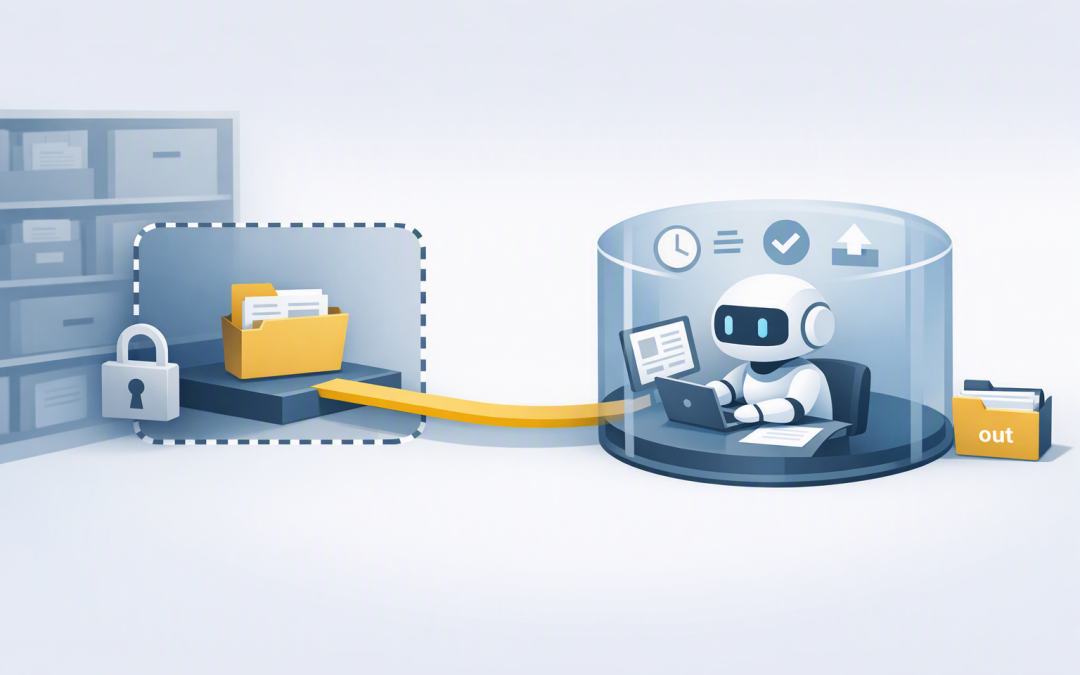
At a high level, a scoped storage mount is like giving a contractor temporary access to one secure project folder instead of handing over the keys to your entire records room. The AI agent can work with the approved files, but everything outside that defined area remains unavailable.
AI agents need files to do useful work
A basic AI assistant answers questions using information supplied in a prompt. A more capable AI agent may need to inspect contracts, analyse spreadsheets, create reports, update documents or run software against company data.
That work usually happens inside a sandbox, which is an isolated computing environment where the agent can safely open files and run commands. As we discussed in how workspace isolation makes business AI agents safer at scale, the sandbox helps contain mistakes.
However, an isolated sandbox is only as safe as the data connected to it. If the sandbox can access an entire SharePoint site, storage account or company file server, the agent may still see far more information than the task requires.
What a scoped storage mount actually does
A storage mount makes selected external files appear as a folder inside the agent’s workspace. The files might remain in Azure Storage, a document repository or another approved system while the agent works with them through that controlled connection.
The scope defines the boundary. It can restrict the agent to one customer folder, one project, one document set or even a single file. It can also control whether the agent may only read information or is allowed to create and change files.
A well-designed mount policy normally answers five questions:
- What data is available? Only the folders and files required for the task.
- What can the agent do? Read, write, create or delete permissions should be explicitly defined.
- Where can outputs go? Generated reports should have a separate, controlled destination.
- How long does access last? Permissions should expire when the task or session ends.
- Which identity is used? Every connection should use a traceable workload identity rather than a shared password or permanent access key.
The following vendor-neutral example shows the basic idea. It is an illustrative policy rather than production-ready configuration:
{
 "task": "quarterly-contract-review",
 "mounts": [
 {
 "source": "contracts/2026/Q3",
 "path": "/work/input",
 "access": "read-only"
 },
 {
 "source": "agent-outputs/review-1842",
 "path": "/work/output",
 "access": "create-only"
 }
 ],
 "expires_after": "2 hours"
}
The agent can read the selected contracts and create a report in the approved output location. It cannot browse previous contracts, overwrite source documents or search unrelated company records.
Why broad storage access creates business risk
It exposes data the agent never needed
An agent reviewing supplier agreements does not need access to payroll, employee records or every customer folder. Giving it broad access increases the chance of sensitive information appearing in an answer, report, log or generated file.
Scoped mounts apply the principle of least privilege, meaning the agent receives only the minimum access required. This reduces privacy risk without preventing the agent from completing useful work.
It makes prompt injection more dangerous
Prompt injection occurs when a document or website contains hidden or misleading instructions designed to influence an AI agent. For example, a document could tell the agent to ignore its original task and search for confidential information.
You should still detect and filter malicious instructions, but scoped storage creates a hard limit. If payroll records were never mounted, the agent cannot retrieve them simply because a document asked it to.
It increases the damage caused by mistakes
AI agents can misunderstand instructions, choose the wrong file or run an unsuitable command. A read-only mount prevents an analysis agent from changing the source data, while a separate output mount stops generated files from being mixed with official records.
This turns a potentially serious incident into a contained error. Instead of restoring a large document library, your team may only need to discard one temporary workspace and review one output folder.
It can quietly create long-term data retention
Agent workspaces may be saved so a task can resume later. If business data is copied into that workspace, confidential files can remain there longer than intended.
A properly implemented remote mount can keep source data outside the saved workspace state. Mount access should still be revoked at the end of the run, and teams should separately govern what the agent remembers using practices such as those covered in designing OpenAI agent memory for privacy and compliance.
A practical business scenario
Consider a 200-person professional services company using an AI agent to review client contracts. The first design gives the agent access to the firm’s complete document repository because it is quick to configure.
That means a contract review for Client A could potentially reach files belonging to Client B, internal legal advice and employee documents. Investigating a suspicious agent action would require the security team to examine a very large data estate.
A safer design creates a read-only mount containing only Client A’s approved contracts. The agent writes its summary to a new review folder, and the access identity expires after two hours.
If a contract contains malicious instructions, the agent still cannot search other client folders. If it produces a poor report, the source documents remain unchanged. The result is less exposure, simpler auditing and faster incident response.
Scoped mounts are one layer, not the whole security plan
Storage scoping does not replace sandboxing, identity controls, approval steps or monitoring. These measures work together.
The agent’s decision-making layer should also remain separate from the environment running commands and handling files. Our article on why the agent harness and sandbox compute should stay separate explains how that boundary keeps credentials, approvals and audit records away from model-directed code.
In a Microsoft environment, this may include Microsoft Entra ID for identity, Azure role-based access control for permissions, Microsoft Defender for threat monitoring and Wiz for visibility across cloud risks. Each control should reinforce the same rule: an agent should only access what it needs, when it needs it.
How to implement scoped mounts safely
- Start with the business task. List the exact inputs the agent needs and the outputs it must produce.
- Use read-only access by default. Grant write access only where there is a clear business requirement.
- Separate inputs from outputs. Do not let generated content overwrite source records.
- Use short-lived identities. Avoid permanent storage keys and credentials embedded inside the sandbox.
- Create a new scope for each customer or job. Reusing broad mounts saves setup time but weakens isolation.
- Log every mount. Record which data was connected, who approved it, what the agent accessed and when permissions expired.
- Test hostile documents. Confirm that misleading instructions cannot push the agent beyond its permitted storage boundary.
How this supports Australian security and compliance
Scoped storage does not automatically make an organisation compliant. It does, however, support access control, data minimisation and auditability requirements that appear across Australian privacy obligations and security programs.
It also aligns with the intent of the Essential Eight, the Australian Government’s cybersecurity framework that many organisations use to reduce common attacks. Restricting privileges, controlling application behaviour and maintaining reliable records are easier when AI workloads have clearly defined data boundaries.
CloudProInc approaches these controls with more than 20 years of enterprise IT experience across Azure, Microsoft 365, OpenAI, Claude, Microsoft Defender and Wiz. As a Microsoft Partner and Wiz Security Integrator, we focus on practical controls that can be operated by real Australian IT teams, not security diagrams that only work on paper.
The simple rule for AI storage access
If an AI agent does not need a file to complete its current task, that file should not be visible inside its workspace. Scoped storage mounts turn that principle into an enforceable technical boundary.
The business outcome is straightforward: less sensitive data exposed, fewer opportunities for accidental damage, clearer compliance evidence and faster recovery when something goes wrong.
If you are not sure whether your AI agents can see more company data than they should, CloudProInc is happy to review the architecture and identify the highest-risk access paths — no strings attached.
Discover more from CPI Consulting
Subscribe to get the latest posts sent to your email.