
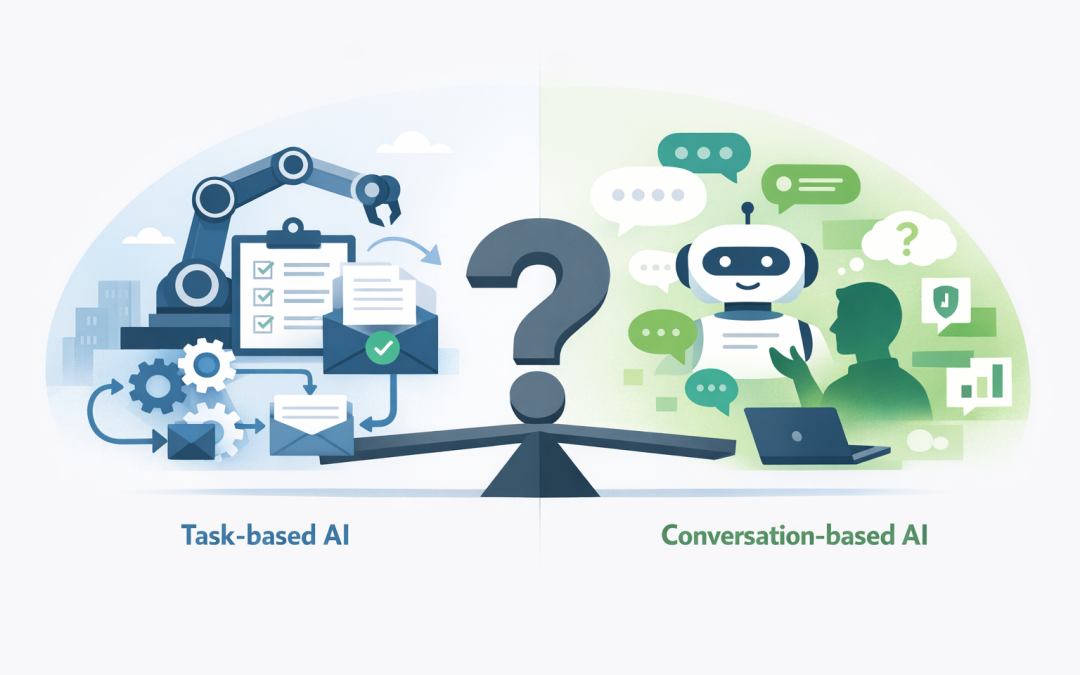
In this blog post Task-Based vs Conversation-Based AI Agents: Which Is Right for Your Business? we will explain the difference in plain English, show where each type fits, and help you avoid spending money on the wrong kind of AI agent.


Many businesses are now asking the same question: “Should we build an AI agent?” The better question is: “What job do we need the agent to do?”
An AI agent is software that can understand a goal, use business systems, make decisions within rules, and complete work with less human effort. Some agents are built to finish a defined task. Others are built to hold a useful conversation, ask questions, and guide a person through a decision.
Those two styles sound similar, but they behave very differently in the real world. Choosing the wrong one can lead to frustrated staff, weak adoption, unexpected costs, or security risks.
The simple difference
A task-based AI agent is built to complete a specific job from start to finish.
For example, it might read an invoice, check the supplier details, match it against a purchase order, flag anything unusual, and send it to the right person for approval. The business outcome is clear: less manual processing, fewer errors, and faster turnaround.
A conversation-based AI agent is built to help people through dialogue.
For example, it might answer HR policy questions, help a manager understand leave entitlements, guide a sales person through pricing rules, or help an executive compare options before making a decision. The business outcome is different: quicker access to knowledge, better decisions, and less time spent searching or asking around.
Think of it this way. A task-based agent is like a reliable operations assistant. A conversation-based agent is like a knowledgeable adviser who can explain, clarify, and guide.
The technology behind AI agents in plain English
Most modern AI agents are powered by a large language model, or LLM. That is the AI engine that understands written instructions, interprets questions, summarises information, and generates responses.
On its own, the model is not enough. A business-ready agent usually needs five extra pieces around it.
- Instructions: the rules that tell the agent what role it plays, what it can do, and what it must avoid.
- Tools: safe connections to systems such as Microsoft 365, Dynamics, ServiceNow, SharePoint, Salesforce, finance platforms, or internal databases.
- Business context: approved information the agent can use, such as policies, process documents, customer records, or previous interactions.
- Guardrails: controls that limit risky behaviour, such as requiring human approval before sending an email, changing a record, or approving a payment.
- Logging and monitoring: records of what the agent did, why it did it, and whether the outcome was correct.
This is where many AI projects succeed or fail. The clever model gets attention, but the surrounding design determines whether the agent is useful, safe, and cost-effective.
At CloudProInc, we often see businesses jump straight into tools before defining the workflow, risk level, and data access model. As a Microsoft Partner and Wiz Security Integrator, we look at AI agents the same way we look at cloud and cybersecurity: useful technology needs clear controls.
When task-based agents make the most sense
Task-based agents are best when the work is repeatable, rules-based, and easy to measure.
Good examples include invoice processing, employee onboarding, IT ticket triage, security alert enrichment, customer request routing, contract review checklists, and monthly reporting packs.
The key word is repeatable. If your team performs the same steps hundreds of times a month, a task-based agent may save real money.
Business outcome 1: lower operating cost
A 180-person services company might have three people spending several hours each week sorting shared mailbox requests, copying information into spreadsheets, and chasing approvals.
A task-based agent could classify the request, extract the important details, check whether anything is missing, and create the right ticket or workflow. Staff still make the judgement calls, but the repetitive handling disappears.
That does not just save time. It also reduces the hidden cost of context switching, where skilled employees lose focus because they are constantly jumping between low-value admin tasks.
Business outcome 2: fewer process errors
Humans are good at judgement. They are not always good at repeating the same process perfectly 200 times.
A task-based agent can apply the same checklist every time. It can remind people when required information is missing, highlight exceptions, and keep an audit trail.
For Australian organisations working toward Essential 8, the Australian government’s cybersecurity framework that many organisations are now expected to align with, this consistency matters. AI agents should support stronger access control, patching, logging, and approval processes — not quietly bypass them.
Business outcome 3: faster response times
Task-based agents are also useful when speed matters.
For example, a cybersecurity agent could review a Microsoft Defender alert, gather related device and identity information, check whether the affected device is managed by Microsoft Intune, which manages and secures company devices, and prepare a summary for the security team.
The agent should not automatically shut down half the business without approval. But it can reduce the time it takes a person to understand the issue and act.
When conversation-based agents make the most sense
Conversation-based agents are best when the user does not know exactly what they need at the start.
That happens a lot in business. A manager may ask, “Can we hire this role in another state?” A sales person may ask, “What discount can I offer?” A CIO may ask, “Which applications are most exposed if this vendor has an outage?”
These are not simple button-click tasks. They require questions, context, explanation, and often a recommendation.
Business outcome 1: better decisions
A good conversation-based agent helps people think through options.
It can summarise a policy, compare scenarios, explain trade-offs, and ask follow-up questions. It can also point out when the user is asking the wrong question.
For example, if an executive asks whether to use ChatGPT or Claude for a department, the agent should not simply list features. It should ask about data sensitivity, integration needs, staff roles, compliance requirements, and budget. We covered that decision in more detail in ChatGPT vs Claude Which AI Is Right for Your Business in 2026.
Business outcome 2: less time wasted searching
Most mid-sized companies have knowledge scattered everywhere: SharePoint folders, Teams chats, PDFs, old emails, ticketing systems, and people’s heads.
A conversation-based agent can become a front door to that knowledge. Staff ask a plain English question and get a plain English answer, ideally with links back to the approved source material.
This is especially valuable for HR, IT support, finance, operations, and compliance teams that answer the same questions every week.
Business outcome 3: higher adoption
People use tools that feel easy.
If your AI project depends on staff learning a complex new system, adoption may be slow. A conversation-based agent can sit inside familiar places such as Microsoft Teams, Microsoft 365 Copilot, or a company portal.
That lowers friction. It also makes governance easier because identity, permissions, and access can often be tied back to Microsoft Entra ID, which controls who can access company systems.
The risk difference most leaders miss
Task-based and conversation-based agents create different risks.
A task-based agent may take action. That means the main risks are incorrect action, excessive permissions, weak approval steps, and poor logging.
A conversation-based agent may influence decisions. That means the main risks are inaccurate advice, outdated information, accidental disclosure of sensitive data, and users trusting the answer too much.
Both need security controls, but not the same controls.
For task-based agents, focus on permissions, approval gates, testing, rollback steps, and monitoring. For conversation-based agents, focus on trusted knowledge sources, data boundaries, answer quality, privacy controls, and clear warnings when the agent is not certain.
This is also where Australian privacy obligations matter. If an agent can access personal information, customer records, employee data, or sensitive business documents, it needs proper governance. Public AI tools are not the right place to paste private customer data or confidential staff information.
A practical decision framework
If you are deciding which type of agent your business needs, start with these questions.
- Is the work repetitive? If yes, consider a task-based agent.
- Does the user need guidance or explanation? If yes, consider a conversation-based agent.
- Does the agent need to change records, send messages, or trigger workflows? If yes, treat it as higher risk and add approvals.
- Does the agent need access to confidential data? If yes, design the identity, permission, and logging model before launch.
- Can success be measured? If not, the use case is probably too vague.
A useful rule: if the desired output is an action, start task-based. If the desired output is understanding, start conversation-based.
Where hybrid agents fit
In practice, many successful agents are a mix of both.
For example, an IT support agent might begin as a conversation. The user says their laptop is slow. The agent asks a few questions, checks device health through Intune, confirms whether updates are pending, then creates a ticket or recommends a fix.
The conversation helps understand the problem. The task-based workflow does the work.
This is where agent orchestration becomes important. Orchestration simply means deciding which agent, tool, or process should handle each step. If you want a deeper explanation, see our guide on AI agent orchestration patterns for business leaders.
A real-world scenario
Imagine a 220-person professional services firm with offices in Melbourne, Sydney, and Brisbane.
The IT team receives around 900 support requests a month. Many are simple: password issues, software access, device problems, onboarding questions, and “where do I find this?” requests.
The leadership team first wanted a chatbot. But after reviewing the workload, it became clear that two agents were needed.
The first was a conversation-based agent for staff questions. It answered approved IT and HR questions using company documentation stored in Microsoft 365.
The second was a task-based agent for IT triage. It classified tickets, checked device and user details, suggested priority, and prepared a support summary before a technician picked it up.
The result was not a flashy AI demo. It was a practical reduction in repetitive work, faster first response times, and better visibility for management.
That is the kind of AI outcome most businesses should be aiming for.
Build, buy, or configure?
You do not always need to build from scratch.
Some agents can be configured using Microsoft Copilot Studio, Azure AI Foundry, or Microsoft 365 tools. Others need custom development using OpenAI, Claude, APIs, and secure workflow design.
The right answer depends on the process, data sensitivity, integration needs, and risk tolerance. We explored that decision in Build or Buy AI Agents and How Enterprises Make the Right Call.
For many 50–500 person organisations, the smartest path is not “build everything.” It is to start with one high-value workflow, prove the result, then expand carefully.
What CloudProInc recommends
Start small, but design properly.
Pick one workflow where the pain is obvious. Measure the current cost in hours, delays, errors, or risk. Then decide whether the agent needs to complete a task, guide a conversation, or combine both.
Before going live, make sure you have clear data boundaries, security controls, human approval steps, and monitoring. Tools like Microsoft Defender and Wiz can help provide visibility across cloud and security environments, but they need to be part of a wider operating model.
Also think about memory carefully. Agents become more useful when they remember the right business context, but memory must be handled safely. We covered this in How to Build AI Agents That Remember Business Context Safely.
Final thought
Task-based AI agents and conversation-based AI agents are both useful, but they solve different problems.
If your goal is to reduce manual effort in a repeatable process, start with a task-based agent. If your goal is to help staff find answers, understand options, or make better decisions, start with a conversation-based agent.
If your business needs both, design the handoff between them carefully. That is where cost, security, and user experience are won or lost.
CloudProInc is based in Melbourne and works with clients across Australia and internationally. With 20+ years of enterprise IT experience across Azure, Microsoft 365, Intune, Windows 365, OpenAI, Claude, Defender, and Wiz, we help businesses turn AI agents from interesting demos into practical business tools.
If you are not sure whether a task-based, conversation-based, or hybrid AI agent is right for your business, we are happy to take a look at your process and give you a practical view — no pressure, no jargon.