
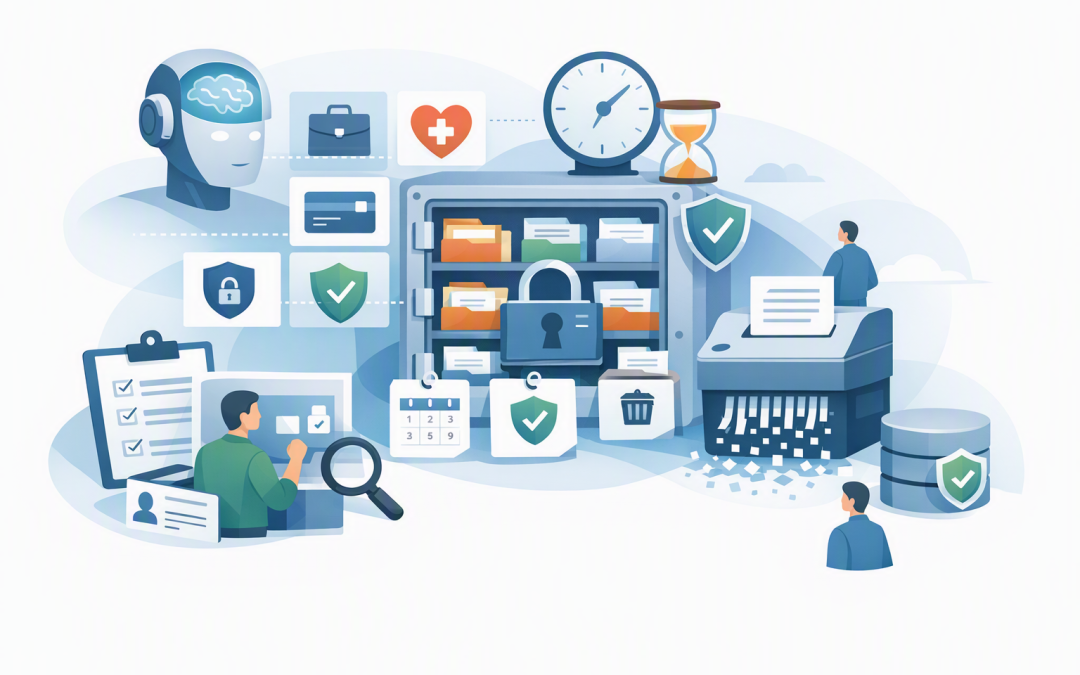
In this blog post How to Design OpenAI Agent Memory for Privacy and Compliance we will explain how to give AI agents useful memory without creating an uncontrolled store of personal, confidential or regulated information.


The business problem is simple. An agent that forgets everything wastes employees’ time, but an agent that remembers everything becomes a privacy and security risk. The goal is not maximum memory. It is the minimum reliable memory needed to complete a legitimate business task.
What OpenAI agent memory actually means
An OpenAI model does not remember business information in the same way an employee does. Your application gives the model relevant context each time it needs to answer a question or take an action.
That context may come from recent conversation history, a customer record, a document library or a separate memory database. OpenAI’s Agents SDK can maintain session history, while longer-term information is commonly stored in a database and retrieved when required.
In plain English, the technology works in four steps:
- The user asks the agent to do something.
- The application identifies the user, their organisation and their permissions.
- It retrieves only the information relevant to that request.
- The model receives that limited context and produces a response or proposed action.
This distinction matters because most privacy failures do not begin inside the model. They begin when an application stores too much, keeps it too long or retrieves information for someone who should not see it.
We previously covered the broader value of context in building AI agents that remember business context safely. Here, we are focusing on the privacy and compliance decisions that should shape the memory architecture itself.
Start by deciding what the agent is allowed to remember
A common mistake is storing complete conversations because they may be useful later. This creates a growing archive containing names, complaints, commercial details, employee information and occasional passwords pasted in by mistake.
Instead, divide memory into clear categories.
- Working memory holds the context needed for the current task and should usually expire quickly.
- Preference memory records approved details such as a user’s preferred report format or office location.
- Business memory stores confirmed facts such as an approved customer status or completed support action.
- Restricted memory includes health, financial, legal, identity and employee relations information that may require stronger controls or should not be stored at all.
Every category should have an owner, approved purpose, retention period and deletion process. If nobody can explain why a memory item must exist, it probably should not be retained.
Store confirmed facts rather than entire conversations
Raw chat history is messy. It includes questions, guesses, corrected information and details unrelated to the final business outcome.
A safer pattern is to extract a short, structured record after the interaction. For example, instead of saving a 30-message support conversation, the agent might store that the laptop replacement was approved, the approval date, the ticket number and who authorised it.
Structured memory is easier to search, secure, correct and delete. It also lowers AI processing costs because the agent does not need to reread pages of old conversation every time the user returns.
Do not allow the agent to silently convert every statement into a permanent fact. Important information should be validated against the relevant business system or confirmed by a person before it becomes trusted memory.
Apply access controls when information is retrieved
Encrypting a memory database is important, but encryption alone does not prevent an authorised employee from receiving someone else’s information. The application must check permissions every time memory is retrieved.
Each memory record should include the company, user, sensitivity, purpose and expiry date. A request should be rejected unless all those details match the person and task involved.
This is especially important for agents serving multiple departments or customers. Finance information must not appear in a general staff assistant, and one customer’s history must never be retrieved during another customer’s conversation.
For Microsoft environments, identity can be connected to Microsoft Entra ID, which manages employee sign-in and access permissions. Microsoft Intune, which manages and secures company devices, and Microsoft Defender, which detects suspicious activity, can add protection around the people and devices using the agent.
Build retention and deletion into the design
AI memory should not become permanent simply because deletion was left for a later project. Set an expiry date when each record is created and remove it automatically when the business need ends.
Retention periods should vary by purpose. Current task context may last hours, user preferences may last until changed, and evidence of an approved transaction may need to follow an established records policy.
Organisations also need a practical way to locate, correct, export or delete information about an individual. That is difficult when personal information has been copied into prompts, logs, test systems and several unrelated databases.
OpenAI API data controls should be reviewed as part of this work, including whether eligible workloads require stricter retention settings. However, vendor retention settings do not delete information held in your own database, backups, monitoring tools or support logs.
If memory must remain available after outages, retention needs to work alongside tested recovery. Our guide to keeping AI agents from losing critical business information explains how to balance reliable recovery with controlled storage.
Use privacy rules before writing to memory
The following simplified example shows the idea. It is not complete production code, but it demonstrates that privacy decisions should happen before information is saved.
def approve_memory(item, user):
 if item.contains_password_or_api_key:
 return "reject"

 if item.category in ["health", "legal", "employee_relations"]:
 return "human_review"

 if not item.has_defined_business_purpose:
 return "reject"

 item.tenant_id = user.tenant_id
 item.owner_id = user.id
 item.expires_at = retention_policy
 item.sensitivity = classify(item)

 return "store"
In a production environment, this policy would be supported by identity checks, encryption, monitoring, approval workflows and automated testing. The important point is that the agent does not make an unrestricted decision to remember something.
Keep an audit trail without copying sensitive content
Leaders need to answer basic questions during an investigation or audit. What did the agent retrieve? Why was it allowed? What action did it recommend? Who approved the final decision?
An audit log should capture those events without duplicating every sensitive prompt and response. Record identifiers, access decisions, timestamps, policy results and approvals, then restrict access to the logs themselves.
For Azure-based environments, Azure Cosmos DB can support durable, access-controlled records when it is designed correctly. We explore that approach in building audit-ready AI agents with Azure Cosmos DB.
Connect AI governance to Australian requirements
Australian organisations should assess agent memory against the Privacy Act and the Australian Privacy Principles where they apply. The practical questions include whether personal information is necessary, whether people would reasonably expect the use, how accuracy is maintained and when the information will be deleted.
The Essential Eight, the Australian Government’s baseline cybersecurity framework, also provides a useful security foundation. Controls such as multi-factor authentication, timely software updates, restricted administration and reliable backups reduce the likelihood that an attacker can reach the systems surrounding agent memory.
Essential Eight compliance does not automatically make an AI agent privacy compliant. It protects the wider technology environment, while the agent still needs purpose limits, data minimisation, access rules, retention controls and accountable human oversight.
A practical scenario
Consider a 200-person professional services firm introducing an agent to help account managers prepare for customer meetings. The first design stores every email, meeting transcript and chat indefinitely.
A privacy-led redesign keeps only approved customer summaries, open actions, document references and the source date. Access follows the employee’s existing customer permissions, sensitive notes require approval, and outdated summaries expire automatically.
The account managers still receive useful preparation in seconds. The business also reduces storage, processing costs, accidental disclosure risk and the amount of information that must be reviewed after a privacy request or security incident.
Useful memory is controlled memory
Good agent memory is not measured by how much the system can retain. It is measured by whether the agent can find the right verified information, for the right person, at the right time, and remove it when it is no longer needed.
CloudProInc combines more than 20 years of enterprise IT experience with practical work across OpenAI, Claude, Azure, Microsoft 365, Defender and Wiz. As a Melbourne-based Microsoft Partner and Wiz Security Integrator, we help organisations design AI systems that fit their security and compliance responsibilities rather than working around them.
If you are unsure what your proposed AI agent will remember, where that information will be stored or who could retrieve it, we are happy to review the design with you — no strings attached.
Discover more from CPI Consulting
Subscribe to get the latest posts sent to your email.