
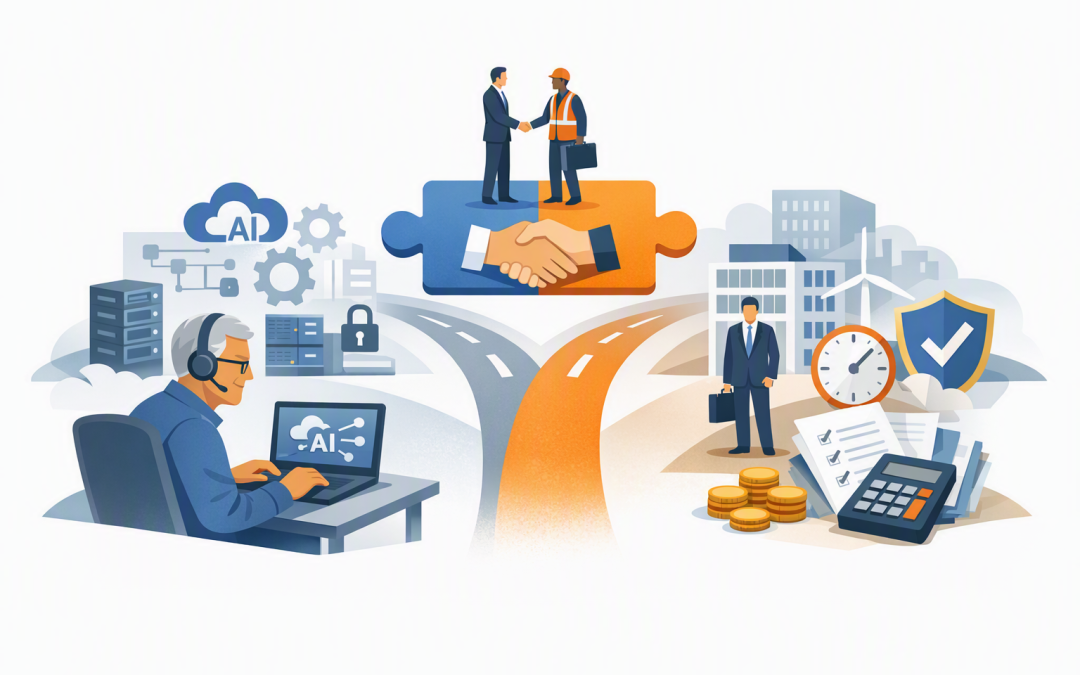
In this blog post Should You Hire or Contract a Senior Forward Deployed Engineer we will explain how to choose the right engagement model without committing too early, wasting budget or leaving an important AI project without the expertise it needs.


Many technology leaders face the same problem. The business wants practical AI results, but the existing team is already busy maintaining systems, supporting employees and managing security. You may need senior engineering capability, but it is not always clear whether that means creating a permanent position or bringing in a specialist for a defined period.
What are you actually hiring this person to do?
A senior forward deployed engineer works closely with your people to turn a business problem into a secure, working technology solution. Unlike a traditional software developer who may receive a fixed list of requirements, this engineer helps discover the requirements, builds the system and adjusts it based on how employees use it.
If you need a more detailed overview, we have covered what a senior forward deployed engineer does for your business. The important point for this decision is that the role combines technical delivery with business understanding.
The technology behind the role usually includes an AI model such as OpenAI or Anthropic Claude, cloud infrastructure such as Microsoft Azure, and connections to business systems containing documents, customer information or operational data. Identity controls determine who can access the system, while security and monitoring tools record how it is being used.
For example, an internal AI assistant might search approved Microsoft 365 documents, prepare a response and show the employee where the information came from. The forward deployed engineer makes those separate parts work together while preventing employees from seeing information they are not authorised to access.
When hiring permanently makes sense
A permanent hire is usually the better choice when AI and automation have become ongoing business capabilities rather than isolated experiments. You are not simply delivering one assistant or workflow. You expect a steady pipeline of projects that will require continuous improvement.
You have enough work for the role
A senior engineer should not spend most of the week waiting for the next approved AI idea. Before hiring, identify at least 12 months of meaningful work across implementation, security, integration, employee adoption and ongoing optimisation.
This work might include connecting AI to internal knowledge, automating service processes, improving software delivery and introducing safeguards around employee AI use. A clear project pipeline makes the fixed cost easier to justify.
You want to build knowledge inside the business
A permanent employee develops a deep understanding of your systems, people and operating constraints. That knowledge can become valuable when AI is expected to influence several departments over multiple years.
Hiring also gives you greater control over priorities. The engineer can move between projects, support internal teams and respond when business requirements change.
You can support a senior specialist properly
Hiring the right person is only part of the investment. They need access to decision-makers, cooperation from business teams and clear authority to address security or data problems.
If the organisation cannot provide these things, even an excellent hire may struggle to produce results. The position can become an expensive technical role with no clear business ownership.
When contracting is the smarter option
Contracting is often more practical when the need is urgent, the project is still being validated or the required expertise is difficult to maintain internally. It allows you to buy focused capability without assuming the work will continue forever.
You need to prove the business case first
Many organisations do not yet know whether an AI use case will save enough time or money to justify a permanent team. A contractor can help design and deliver a controlled pilot with clear measures such as hours saved, response times reduced or manual steps removed.
This approach is especially useful when deciding whether to build or buy AI agents. You can test the assumptions before committing to a product, platform or long-term employee.
Your internal team has a temporary capability gap
Your existing technology team may understand the business well but lack experience with AI models, Azure integration or enterprise security. A senior contractor can fill that gap while transferring practical knowledge to your employees.
This is different from outsourcing the entire project and hoping for the best. A good forward deployed engineer works alongside your team, documents decisions and helps internal staff operate the finished system.
You need progress quickly
Recruiting a senior specialist can take months. There is also no guarantee that a strong candidate will have experience across AI, cloud infrastructure, security and stakeholder management.
A qualified contractor can often begin with a defined discovery phase, identify the main risks and create a delivery plan. This gives leadership useful information even if the organisation later decides to recruit permanently.
The cost comparison is bigger than salary versus day rate
A contractor’s daily rate can look expensive beside an employee’s salary. However, that comparison leaves out recruitment fees, superannuation, leave, equipment, management time, training and the risk of hiring before the workload is proven.
Contracting also has hidden risks. A poorly structured engagement can create dependency on one person, weak documentation or a system that your internal team cannot maintain. The contract should therefore include knowledge transfer, documentation, security responsibilities and a clear handover plan.
The right question is not simply which option costs less. It is which option gives the business the required result with an acceptable level of delivery and security risk.
A practical mid-sized business scenario
Consider an anonymised composite scenario based on common mid-market projects. A 200-person professional services company wants an AI assistant to search policies, prepare client documents and answer internal questions. Management believes it could save thousands of employee hours, but the data is spread across Microsoft 365, shared drives and several business applications.
Hiring immediately would be risky because the company does not yet know whether employees will adopt the assistant or whether the information is organised well enough. Instead, it contracts a senior forward deployed engineer to test one department, establish access controls and measure the time saved.
The pilot reveals that the AI model is not the main challenge. The larger problems are outdated documents, inconsistent permissions and unclear ownership of sensitive data. Fixing those issues first reduces security risk and improves the reliability of the assistant.
Once the pilot demonstrates ongoing demand across several departments, the company can recruit an internal engineer with a much clearer position description. The contractor can then help interview candidates and transfer the solution. This is often safer than making a permanent hire based on assumptions.
A hybrid model often delivers the best result
The decision does not have to be entirely hire or contract. Many organisations use a contractor to validate the opportunity, establish the technical foundation and reduce early project risk. They then hire internally when the workload and required skills are understood.
This model can also work in reverse. An internal engineering leader can own the long-term roadmap while contractors provide specialist help for complex integrations, security reviews or short periods of intensive delivery.
It is important to distinguish this work from architecture alone. Our guide to senior forward deployed engineers versus solutions architects explains why designing a system and working inside the business to deliver it are related but different responsibilities.
Five questions to ask before deciding
- Do we have one defined project or an ongoing pipeline? A defined project often suits a contractor. A reliable multi-year pipeline may justify hiring.
- How quickly do we need results? Contracting can reduce the delay caused by a lengthy recruitment process.
- Can we manage this role effectively? A permanent specialist needs clear priorities, executive support and access to business teams.
- What knowledge must stay inside the company? Identify what should be owned internally and require contractors to document and transfer it.
- How will we measure success? Use business measures such as money saved, processing time reduced, errors prevented or security risks addressed.
Security should also be part of the decision from the beginning. AI systems may interact with confidential company information, so access controls, data protection and alignment with the Essential 8 — the Australian government’s cybersecurity framework for reducing common attacks — cannot be added as an afterthought.
Choose based on certainty, not enthusiasm
Hire when you have a sustained need, a strong internal roadmap and the management structure to support a senior engineer. Contract when you need speed, specialist experience or evidence that the opportunity is worth a long-term investment.
CloudProInc combines more than 20 years of enterprise IT experience with hands-on expertise across Azure, Microsoft 365, AI and cybersecurity. As a Microsoft Partner and Wiz Security Integrator, we help organisations connect AI systems to real business processes without overlooking identity, cloud security or compliance.
If you are unsure whether you have enough work for a permanent forward deployed engineer, or need help defining a safe first engagement, CloudProInc is happy to review the situation with you. There is no pressure to choose a particular model — the goal is to find the approach that delivers useful results without creating unnecessary cost or risk.