
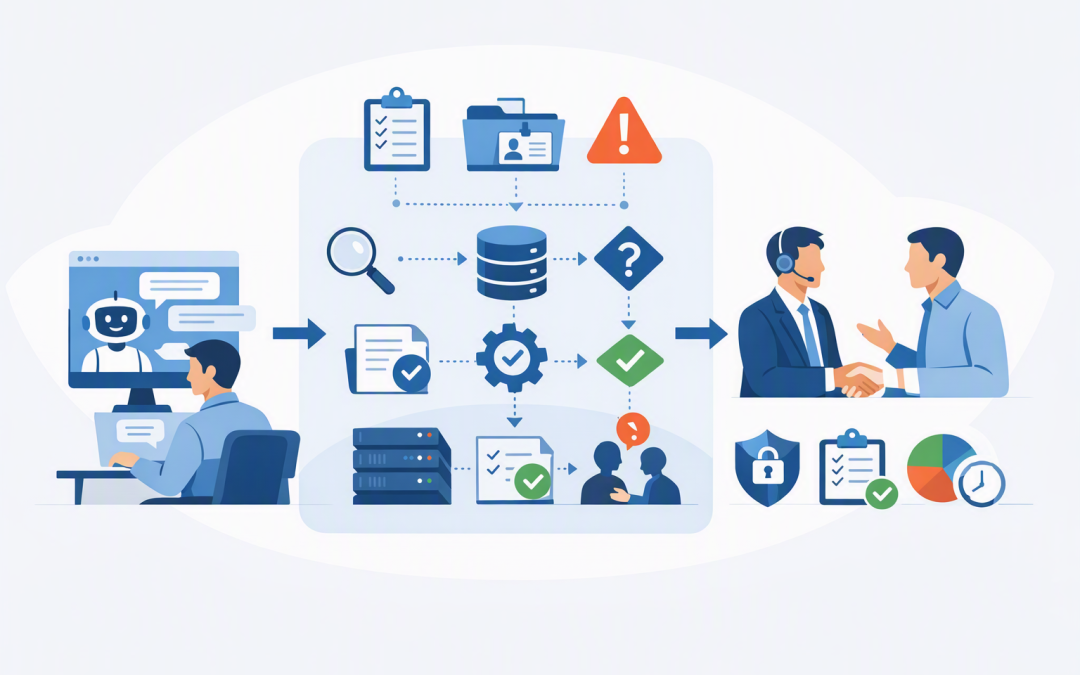
In this blog post How to Design AI Conversations Around Real Business Processes we will explain how to turn an AI chat experience into a controlled workflow that reduces delays, rework and operating costs.


Many AI projects look impressive in a demonstration but struggle in daily operations. The AI answers questions fluently, yet employees still copy information into another system, chase approvals and ask a person to fix exceptions.
The problem is usually not the AI model. It is that the conversation was designed as a chatbot rather than as part of a real business process.
What is a business-focused AI conversation
A business-focused AI conversation guides someone from a request to a defined outcome. That outcome might be creating an IT ticket, checking an invoice, onboarding an employee, preparing a customer response or escalating a security incident.
The conversation is simply the front door. Behind it, the AI must understand the request, collect the right information, apply business rules, interact with approved systems and know when a person needs to take over.
This builds on the need for an AI conversation strategy before development. Once the boundaries and audience are clear, the next step is connecting the conversation to the way work actually moves through your organisation.
The technology behind the conversation
Several technologies work together to make a business-ready AI conversation possible. Decision-makers do not need to understand the code, but they should understand the moving parts.
- A language model, such as an OpenAI or Anthropic Claude model, interprets everyday language and produces a useful response.
- Instructions define what the AI is allowed to do, what information it must collect and when it must stop or escalate.
- Business knowledge gives the AI access to approved policies, product information and internal procedures rather than relying on general internet knowledge.
- Tool calling allows the AI to request an action from another system, such as looking up a customer record or creating a Microsoft 365 support ticket.
- Conversation state keeps track of relevant details during the interaction so the user does not have to repeat themselves.
- Orchestration controls the order of steps and determines which AI agent, system or person handles each part of the process.
The important point is that the AI should not have unlimited access or authority. It should operate through specific, controlled tools that perform clearly defined actions.
Start with the process rather than the prompt
A common mistake is asking, “What should the AI say?” The better starting question is, “What needs to happen for this request to be completed correctly?”
Before designing the conversation, document six elements:
- The trigger — what causes the process to begin.
- The intended outcome — what “complete” means to the business.
- The required information — what the AI must collect or retrieve.
- The decision points — which rules, approvals or risk checks apply.
- The system actions — what must be recorded, updated or created.
- The exceptions — when a person must review or take over.
This also helps determine whether you need a conversational experience, an automated background process or a combination of both. Our guide to task-based and conversation-based AI agents explains that distinction in more detail.
Turn the process into a conversation contract
A conversation contract is a plain-English definition of what the AI must achieve. It keeps the experience focused and gives developers, process owners and security teams something concrete to review.
Business outcome: Create a complete software access request
Required details:
 - Employee name and department
 - Requested application
 - Business reason
 - Manager approval

AI may:
 - Check the approved software catalogue
 - Confirm the employee's manager
 - Create a service request

AI may not:
 - Approve its own request
 - Grant administrator access
 - Access unrelated employee records

Human handoff:
 - Privileged access is requested
 - The application is not approved
 - Identity or approval cannot be verified
This is more useful than a large prompt filled with vague instructions such as “be helpful.” It connects every conversational step to a business requirement and makes testing easier.
Design for missing information and exceptions
Real business requests rarely arrive complete. An employee might ask, “Can you give Sarah access to the finance system?” without providing Sarah’s team, role, manager approval or required access level.
A well-designed AI conversation asks only the questions needed to move forward. It should explain why sensitive information is required, confirm important details before taking action and avoid asking for information it can safely retrieve from an approved system.
It must also handle exceptions without pretending everything is fine. If an approval is missing or two systems contain conflicting information, the AI should pause the process and send a clear summary to the appropriate person.
For processes involving several specialist agents or systems, choose the handoff sequence deliberately. Different options are covered in our explanation of AI agent orchestration patterns.
An illustrative business scenario
Consider a 180-person professional services company handling software access requests through a shared IT mailbox. Requests arrive with missing information, creating repeated emails between employees, managers and IT staff.
An AI conversation could identify the employee, check the approved application catalogue, collect the business reason, confirm the manager and create a complete service request. Requests involving administrator privileges or unapproved software would automatically go to a security reviewer.
If the company received 30 requests each working day and removed 12 minutes of administration from each request, it could recover approximately 1,320 staff hours per year. At an assumed employment cost of A$55 per hour, that represents A$72,600 of productive time.
That figure is not automatically a cash saving. The value may instead appear as faster service, fewer interruptions, less overtime or more time for IT staff to work on security and improvement projects.
Build security into each step
An AI agent connected to business systems can create risk if its access is too broad. It should use the same basic security principles applied to employees and applications.
- Give the AI access only to the information and actions required for its role.
- Verify the user before displaying sensitive information or taking action.
- Require human approval for high-risk, financial or privileged activities.
- Record tool calls and important decisions for audit and investigation.
- Validate information returned by connected systems before acting on it.
- Keep only the conversation history needed for the business purpose.
Australian organisations should align these controls with the Essential Eight, the Australian Government’s cybersecurity framework for reducing common security risks. AI does not replace controls such as application management, access restrictions, patching and multi-factor authentication.
Conversation records also require deliberate privacy and retention decisions. Storing every message indefinitely is rarely the right answer, as explained in our guide to storing AI conversation history in business systems.
Measure completed work rather than impressive answers
User satisfaction matters, but it does not prove that the AI is improving the process. A friendly conversation can still create more work behind the scenes.
Useful measures include completion rate, average handling time, human handoff rate, number of missing fields, rework, cost per completed request and policy exceptions. Review these measures by process type because a low handoff rate may be desirable for basic questions but dangerous for high-risk approvals.
Start with one process that is frequent, measurable and currently causes frustration. Map it with the people who perform the work, test the difficult cases and introduce broader system access only after the controls are proven.
The conversation is only one part of the system
Successful AI conversations combine a clear business outcome with reliable system connections, limited permissions, human oversight and ongoing measurement. The goal is not to make the AI sound more human. The goal is to help people complete work correctly and with less effort.
CloudPro Inc brings more than 20 years of enterprise IT experience to this work, with hands-on expertise across Azure, Microsoft 365, OpenAI, Claude, Microsoft Defender and Wiz. As a Melbourne-based Microsoft Partner and Wiz Security Integrator, we help organisations design practical AI processes without separating the conversation from security, identity and operations.
If you have an AI conversation that gives good answers but does not complete useful work, we are happy to review the process and identify what is missing — no strings attached.