
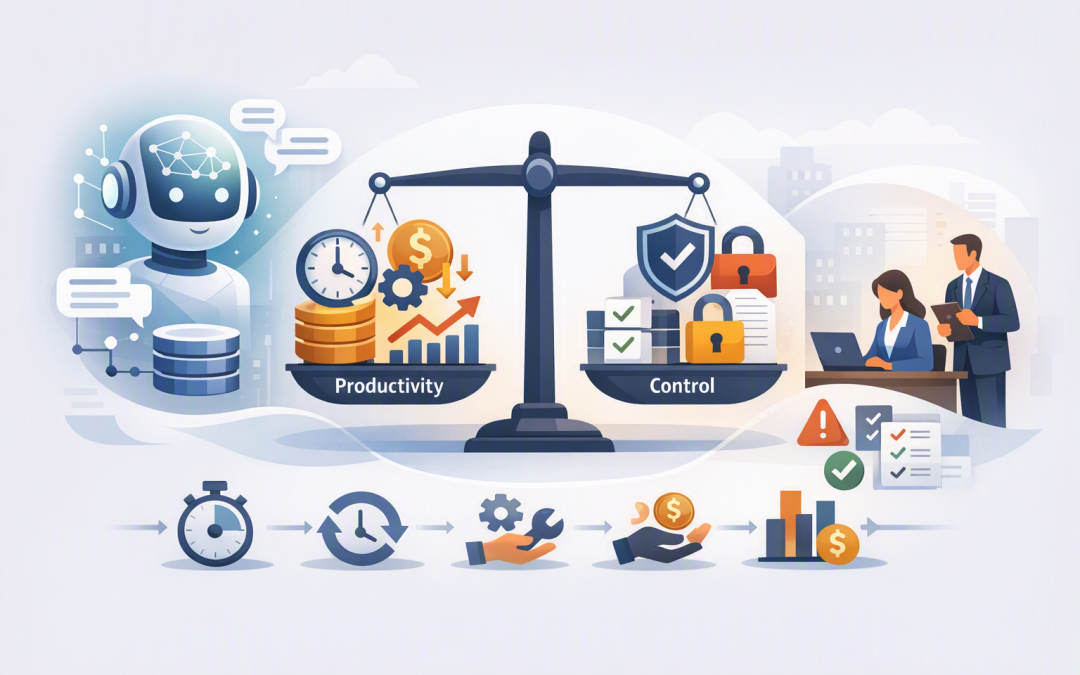
In this blog post How CloudProInc Designs OpenAI Conversations for Business Results we will explain how we turn an OpenAI conversation into a practical business tool that saves time, reduces risk and helps employees complete work more consistently.


Many organisations start with a chatbot and quickly discover that impressive answers do not always produce useful results. Employees still copy information between systems, managers still check every response, and nobody can clearly show whether the AI is saving money.
The problem is rarely the OpenAI model itself. The problem is that the conversation was designed around what the technology can say, rather than what the business needs to achieve.
We start with the outcome, not the chatbot
Before discussing prompts, integrations or model choices, CloudProInc asks a simpler question: what should be faster, cheaper, safer or more consistent after this solution is introduced?
A useful outcome might be reducing the time required to prepare a customer proposal from two hours to 30 minutes. It could be helping the service desk resolve common requests without escalation, or checking supplier documents before they reach a manager.
This creates a measurable starting point. Instead of reporting that employees sent 10,000 AI messages, the business can track hours saved, turnaround times, rework, escalation rates and customer response times.
This builds on our approach to designing AI conversations around real business processes. The process defines the work that must happen. The conversation design determines how the AI gathers information, makes decisions within set boundaries and guides the user towards completion.
How the technology works in plain English
An OpenAI model is a large language model, which means it has learned patterns from very large amounts of text and other information. When someone asks a question, it generates a response based on the instructions, context and data available to it.
It does not automatically understand your policies, approval limits, customer records or definition of a successful outcome. Those business rules must be deliberately added to the solution.
CloudProInc typically designs the conversation using six connected parts:
- Instructions: The rules defining what the AI should do, how it should respond and what it must never do.
- Business context: Approved policies, product information, procedures and other material needed to complete the work.
- Conversation state: The information already collected during the interaction, so users do not need to repeat themselves.
- Tools: Controlled connections that allow the AI to retrieve information or request an action from another business system.
- Structured outputs: A predictable response format that software can read reliably, rather than an uncontrolled block of text.
- Human handoffs: Clear points where the AI stops and sends the matter to an authorised employee.
The OpenAI model handles language and reasoning, while the surrounding design provides control. That distinction is important because a confident-sounding answer is not the same as an approved business decision.
We design the shortest conversation that can complete the work
Long conversations create friction. If an employee must answer 15 questions before receiving anything useful, they will often return to email, spreadsheets or manual work.
CloudProInc maps the minimum information needed to reach the desired outcome. We separate essential questions from information the AI can safely retrieve from an approved system.
For example, an internal purchasing assistant may need the item, business reason, expected cost and required date. It should not ask the employee to type their department, manager and approval limit if that information already exists in Microsoft 365 or another authorised company system.
This reduces handling time and data-entry mistakes. It also makes adoption easier because the AI feels like a quicker way to complete work, not another administrative burden.
Business rules sit outside the model
One of the most common design mistakes is placing every rule inside a large prompt and hoping the model applies them perfectly. That is risky when the conversation affects payments, customer commitments, access permissions or compliance.
Important controls should be enforced by the application and connected systems. The AI can explain an approval rule, but it should not be able to bypass that rule.
A simplified design might look like this:
Outcome: Prepare a purchase request

AI responsibilities:
- Collect missing information
- Summarise the business reason
- Identify the correct request category

System controls:
- Confirm the employee's identity
- Check the approval limit
- Record the request
- Route it to the authorised manager

Human decision:
- Approve, reject or request more information
This separation gives leaders a clearer audit trail. It also reduces the chance that a cleverly worded request can convince the AI to ignore company policy.
We give the AI only the information it needs
An AI assistant does not need unrestricted access to every document, mailbox and customer record. Broad access increases privacy, security and compliance risk without necessarily improving the result.
CloudProInc applies the principle of least privilege, meaning the conversation receives only the minimum access needed for its purpose. A human resources policy assistant may need published workplace policies, for example, but not payroll records or private employee case files.
For Australian organisations, this supports sensible handling of personal information under privacy obligations. It also complements the Essential Eight, the Australian Government’s cyber security framework that helps organisations reduce common security risks, by reinforcing identity, access and application controls around the AI service.
Where OpenAI business services or the API are used, data handling settings, retention, user access and connected applications still need to be reviewed. A vendor’s security features do not replace the organisation’s responsibility to configure and govern the solution properly.
We test complete conversations, not impressive answers
A demonstration usually follows the happy path. A real employee may provide incomplete information, change direction halfway through, paste sensitive data or ask the AI to perform something outside its authority.
CloudProInc tests these situations before wider release. We check whether the conversation asks useful follow-up questions, refuses unsafe requests, uses the correct business information and escalates when confidence is low.
We also create evaluations, which are repeatable tests that compare AI outputs against agreed expectations. These tests help detect changes in quality when instructions, company documents, integrations or OpenAI models are updated.
The measures depend on the outcome. A proposal assistant might be assessed on preparation time, pricing accuracy and required disclaimers. A service assistant might be measured on resolution rate, incorrect advice and the percentage of requests safely handed to a person.
A practical business scenario
Consider a 180-person professional services company where account managers prepare client briefing packs. Each pack requires information from meeting notes, standard service descriptions, previous proposals and internal delivery guidelines.
A basic chatbot can help write the document, but the account manager still has to find the source material, check the claims and format the result. The writing is faster, yet the overall process has barely changed.
An outcome-based conversation works differently. It confirms the client and meeting purpose, retrieves only approved material, identifies missing information, drafts the pack in a standard structure and flags statements requiring human confirmation.
The final approval remains with the account manager. However, the time spent searching, copying and formatting can be reduced significantly, while mandatory sections are less likely to be missed.
That is the difference between an AI feature and a business solution.
The model choice comes after the workflow
Not every conversation needs the largest or most expensive model. Some activities require deeper reasoning, while others need speed, predictable formatting or simple classification.
CloudProInc selects models after understanding the sensitivity, complexity, response-time requirement and expected volume. We may also compare OpenAI with alternatives such as Anthropic Claude where that supports the client’s requirements and avoids unnecessary dependence on one provider.
Our guide to task-based and conversation-based AI agents explains when a conversation is appropriate and when a more tightly controlled automated task is the better option. Leaders comparing platforms can also use our practical framework for AI vendor selection.
What a successful OpenAI conversation should deliver
A well-designed conversation should produce evidence of business value. Depending on the use case, that may include:
- Less employee time spent searching, rewriting and entering data.
- Faster customer, supplier or internal response times.
- More consistent application of company policies and templates.
- Fewer mistakes and less management rework.
- Controlled access to sensitive information.
- Clear escalation and human accountability.
- A measurable cost per completed business outcome.
CloudProInc brings more than 20 years of enterprise IT experience to this work, together with practical expertise across OpenAI, Claude, Azure, Microsoft 365, Intune, Microsoft Defender and Wiz. As a Microsoft Partner and Wiz Security Integrator, we look at the entire operating environment rather than treating the AI conversation as an isolated experiment.
If your AI pilot produces interesting answers but no clear savings, risk reduction or productivity gain, the conversation may be designed around the technology rather than the outcome. CloudProInc is happy to take a practical look at the workflow and identify where it can deliver measurable value, with no strings attached.
Discover more from CPI Consulting
Subscribe to get the latest posts sent to your email.